

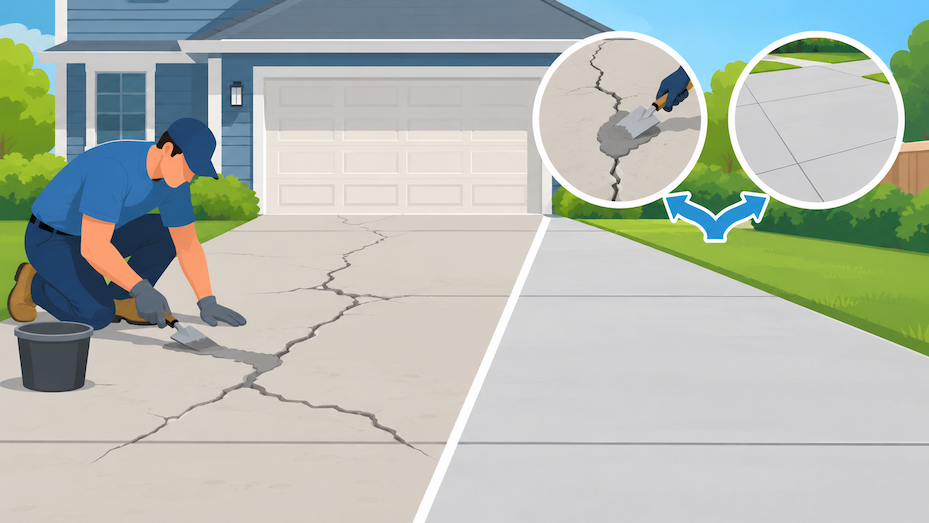
A cracked driveway does not automatically need to be replaced. Small, stable cracks in an otherwise sound surface can often be repaired, while widespread cracking, uneven sections, sinking, and recurring damage may indicate that partial or complete replacement is the better long-term solution.
The right choice depends on the severity of the damage, the condition of the underlying base, drainage, and whether the cracks are still moving. For homeowners in South Florida, identifying these problems early can help prevent further deterioration and unnecessary renovation costs.
This guide explains how to assess driveway cracks, compare repair and replacement options, and decide what to do next.
Key Takeaways
-
Repair is often appropriate for isolated, stable cracks when the surrounding driveway remains structurally sound.
-
Replacement may be necessary when damage affects large areas, sections have shifted, or the underlying base has failed.
-
Recurring cracks need investigation. Filling a crack without addressing settlement, drainage, or movement may only provide temporary results.
-
Uneven surfaces are a warning sign. Raised or sunken sections can indicate problems beneath the driveway.
-
A professional inspection helps determine the scope. Repairing a section or replacing the entire driveway should depend on its overall condition, not appearance alone.
How Can You Tell Whether a Driveway Crack Is Serious?
The seriousness of a driveway crack depends on its width, depth, pattern, movement, and surrounding damage. A narrow crack in a level, stable surface is generally less concerning than a growing crack accompanied by crumbling concrete or uneven sections.
Use the following guide as an initial assessment, not a definitive structural diagnosis.
| Crack or Damage Type | What It May Indicate | Recommended Next Step |
|---|---|---|
| Fine, isolated surface crack | Shrinkage or minor surface movement | Monitor and consider a suitable repair |
| Stable, localized crack | Localized damage in an otherwise sound surface | Evaluate for targeted repair |
| Wide or deep crack | More substantial cracking or possible underlying movement | Arrange a professional assessment |
| Crack with raised or sunken edges | Settlement, base failure, or ground movement | Investigate the underlying cause |
| Multiple interconnected cracks | Widespread deterioration or structural distress | Assess whether partial or full replacement is appropriate |
| Repeated cracks in repaired areas | Unresolved movement, drainage issues, or an unsuitable repair | Investigate the cause before repairing again |
There is no single crack-width measurement that determines whether every driveway needs replacement. A relatively narrow crack can still be significant if the slab is moving, while a wider but stable crack may be repairable under the right conditions.
The key is to evaluate the entire driveway rather than judging the damage by width alone.
When Can a Cracked Driveway Be Repaired?
A cracked driveway can often be repaired when the damage is localized, the surface remains stable, and the underlying base is in good condition. Targeted repairs are generally more practical when most of the driveway remains usable and the surrounding material is not deteriorating.
Are Small Surface Cracks Worth Repairing?
Yes. Small, stable cracks are often good candidates for repair because they may be addressed before water and debris contribute to further deterioration.
Common causes include concrete shrinkage, temperature changes, and minor surface movement. However, the cause should be considered before choosing a repair material.
Depending on the driveway material and crack condition, suitable solutions may include:
-
Crack sealing: Helps limit water entry into appropriate stable cracks.
-
Concrete crack filling: Fills compatible cracks where the selected product suits the crack’s condition.
-
Localized patching: Replaces small areas of damaged or deteriorated surface material.
-
Joint maintenance: Restores appropriate joint sealing where existing joints have deteriorated.
The repair method should match the material and the type of damage. For more detailed guidance on repair methods and preparation, read How to Repair Large Cracks in a Concrete Driveway.
Can a Driveway With Several Cracks Still Be Saved?
Yes, sometimes. Multiple cracks do not automatically mean that an entire driveway must be replaced if the surface remains stable and the damage is limited to repairable areas.
A contractor should inspect whether the cracks are isolated, whether the concrete between them remains sound, and whether any sections have shifted. If the cracks are spreading across the driveway or accompanied by extensive surface deterioration, repeated patching may not provide good long-term value.
For paver driveways, localized repairs may be especially practical because individual units can often be removed, the base corrected, and the pavers reinstalled or replaced.
When Does a Cracked Driveway Need Replacement?
Driveway replacement becomes more practical when the damage is widespread, the surface has lost stability, or the underlying support can no longer provide a reliable foundation. Replacing the affected area may be enough in some cases, but extensive deterioration can justify rebuilding the entire driveway.
What Does Widespread Cracking Mean?
Widespread cracking occurs when damage appears throughout multiple sections rather than in one isolated area. In concrete, interconnected cracks, crumbling surfaces, and extensive deterioration can indicate that the existing slab is approaching the end of its useful service life or has underlying problems.
Replacement deserves consideration when:
-
Large portions of the driveway are cracked.
-
Concrete is breaking apart or losing material in several locations.
-
Previous repairs have failed repeatedly.
-
The surface has become difficult to maintain.
-
Multiple areas show settlement or displacement.
-
The cost of repeated repairs is becoming difficult to justify.
The contractor should determine whether the entire driveway needs replacement or whether removing and rebuilding only the damaged sections would be sufficient.
Why Are Uneven or Sunken Driveway Sections Concerning?
Uneven sections may indicate that the soil or base beneath the driveway has shifted, compacted unevenly, eroded, or been affected by water. Filling the visible crack will not correct these underlying problems.
Look for the following warning signs:
-
One side of a crack sits higher than the other.
-
Sections sink under vehicle traffic.
-
Water collects in depressions after rainfall.
-
The driveway separates from adjacent walkways or structures.
-
The edges crumble around sunken areas.
-
Cracks continue to develop after previous repairs.
The correct solution depends on the cause. Depending on the material and site conditions, a contractor may recommend correcting the base, stabilizing the affected area, rebuilding a section, or replacing the driveway.
What If the Same Cracks Keep Coming Back?
Recurring cracks usually mean that the underlying cause has not been adequately addressed, or that the repair method is not suited to the conditions. Repeatedly applying filler without investigating movement, drainage, or base problems can waste money.
Before approving another repair, ask the contractor to explain:
-
Why the original crack developed.
-
Whether the crack is still moving.
-
Whether the base or soil has shifted.
-
Whether water is contributing to the damage.
-
Why the proposed repair is expected to last.
A replacement is not automatically necessary, but repeated repair failures are a strong reason to reassess the entire driveway.
Driveway Repair vs. Replacement: Which Is Better?
Repair is generally more suitable for isolated damage in a stable driveway, while replacement is often more appropriate when deterioration is widespread or the supporting base has failed. The best decision balances the current condition, expected durability, total cost, and the likelihood of future repairs.
| Factor | Repair | Replacement |
|---|---|---|
| Extent of damage | Localized cracks or small damaged areas | Widespread cracking or extensive deterioration |
| Surface stability | Existing surface remains level and stable | Significant settlement or displacement |
| Underlying base | Generally sound or repairable locally | Requires extensive reconstruction |
| Initial investment | Usually lower for limited damage | Usually higher because of removal and reconstruction |
| Appearance | Repairs may remain visible | Provides an opportunity for a more uniform finish |
| Long-term outlook | Good when the cause is corrected | May be more practical when repairs are no longer reliable |
These are general guidelines rather than universal rules. A localized area with serious base failure may need rebuilding even if the rest of the driveway is in good condition.
Likewise, a driveway with several stable cracks may still be a reasonable candidate for repair.
How Much Does Driveway Repair Cost Compared With Replacement?
Repair usually costs less upfront when only a small area needs attention. Replacement involves additional work, which may include demolition, disposal, excavation, base preparation, drainage improvements, materials, and installation.
The actual price depends on the driveway’s size, material, accessibility, labor requirements, and the extent of the underlying damage.
Before choosing the lowest estimate, compare what each contractor includes in the proposed work. A low-cost patch may not be the best value if it leaves the cause of the cracking unresolved.
For budgeting guidance, see How Much Does Driveway Replacement Cost Per Square Foot?.
What Should You Do When You Discover a Driveway Crack?
The best next step is to document the damage, check for warning signs, and determine whether a simple repair or professional evaluation is appropriate. Acting early can help prevent a manageable maintenance issue from developing into a more extensive renovation project.
Follow these steps before deciding on a repair or replacement.
Step 1: Inspect the Entire Driveway
Walk around the driveway and look for additional cracks, crumbling edges, depressions, raised sections, and standing water.
Take photographs of the damaged areas and note whether the cracks are isolated or spread across the surface. This information can help you explain the problem when requesting an estimate.
Step 2: Check for Changes Over Time
Mark the location of visible cracks in your notes and take photographs from consistent angles. Check whether the cracks are widening, whether the surface is shifting, and whether new damage appears.
Do not rely on monitoring alone if there is substantial displacement, a clear trip hazard, or rapid deterioration. Those conditions warrant prompt assessment.
Step 3: Look for Drainage Problems
Water can contribute to erosion, weakening of the supporting base, and recurring surface damage. Check whether rainwater collects around cracks, flows toward the home, or washes away soil near the driveway edges.
Correcting drainage may be an essential part of a durable repair or replacement project.
Step 4: Request an On-Site Assessment
If the damage is extensive, recurring, deep, or accompanied by uneven sections, arrange an inspection with a qualified driveway contractor.
Ask the contractor to evaluate the surface, base, drainage, and any visible signs of movement. Request an explanation of why the proposed repair or replacement is appropriate for your property.
Step 5: Compare Written Estimates
If the project involves significant repairs or full replacement, obtain detailed written estimates where practical.
Each estimate should explain the proposed work, materials, demolition requirements, base preparation, drainage corrections, expected schedule, and warranty terms where applicable.
Comparing the scope of work makes it easier to understand whether the contractors are addressing the same problems.
Should You Repair or Replace a Driveway in South Florida?
South Florida homeowners should pay particular attention to drainage, heavy rainfall, soil conditions, and prolonged exposure to heat. These factors can contribute to driveway deterioration, especially when the original installation has inadequate base preparation or poor water management.
A driveway inspection should consider more than the visible cracks.
How Does Rainwater Affect Driveway Damage?
Heavy rainfall can expose drainage problems and contribute to erosion around driveway edges or beneath the surface. Water that repeatedly collects in low areas may also indicate that the existing slope or drainage system needs attention.
Before repairing or replacing a driveway, determine where runoff travels and whether water is affecting the supporting base. A durable solution should address these conditions rather than simply cover the visible damage.
Should You Keep the Existing Material or Choose Something Different?
If replacement is necessary, it may be an opportunity to select a material that better suits your property, maintenance preferences, and budget. However, changing materials will not solve poor drainage or inadequate base preparation by itself.
Review Concrete vs. Pavers: Which Works Best in South Florida? to compare two common driveway options, including their durability, maintenance, repairability, and installation considerations.
You can also explore the best driveway materials for South Florida homes if you are considering alternatives.
How Can You Prevent Driveway Cracks From Getting Worse?
Regular inspections, proper drainage, and timely maintenance can help limit avoidable driveway deterioration. Although no maintenance routine can prevent every crack, addressing early warning signs can reduce the risk of more extensive damage.
Consider these practical measures:
-
Keep drains and nearby drainage channels clear.
-
Address standing water and visible erosion promptly.
-
Repair suitable small cracks before they deteriorate.
-
Avoid placing loads on surfaces that are visibly unstable.
-
Maintain concrete joints and paver joints as appropriate for the material.
-
Inspect the driveway after severe weather or noticeable ground movement.
-
Have recurring cracks evaluated instead of repeatedly filling them.
The quality of the original installation also matters. Proper grading, base preparation, compaction, and material selection help establish the conditions needed for a durable driveway.
When Should You Call a Professional Driveway Contractor?
You should seek professional advice when cracks are widening, sections are uneven, damage is widespread, or repairs repeatedly fail. An experienced contractor can assess the driveway’s condition and explain whether targeted repairs, section replacement, or complete reconstruction is the most practical option.
Before hiring a contractor, ask:
-
What is the likely cause of the damage?
-
Is the existing base stable?
-
Can the affected section be repaired independently?
-
What work is needed to correct drainage or settlement?
-
What are the expected benefits and limitations of the proposed repair?
-
What is included in the estimate and warranty?
For a driveway project in South Florida, Top Renovations provides driveway renovation services and offers homeowners a way to discuss their project requirements and request an estimate.
The goal is to understand the problem and select a solution that fits the property’s condition, rather than committing to replacement before the damage has been properly assessed.
Final Thoughts: Repair the Cause, Not Just the Crack
A cracked driveway can often be repaired when the damage is limited and the existing surface remains stable. However, widespread cracking, sinking sections, recurring damage, and signs of base failure may indicate that replacement is the more practical long-term investment.
Start by assessing the crack pattern, checking for movement and drainage problems, and evaluating the condition of the surrounding surface. When the cause is unclear or the damage is extensive, obtain a professional inspection before deciding on the scope of work.
For South Florida homeowners, a durable result depends on more than filling cracks or installing a new surface. Proper drainage, a stable base, suitable materials, and quality workmanship all contribute to long-term driveway performance.
The smartest decision is the one that addresses the actual cause of the damage and provides reliable performance for years to come.