

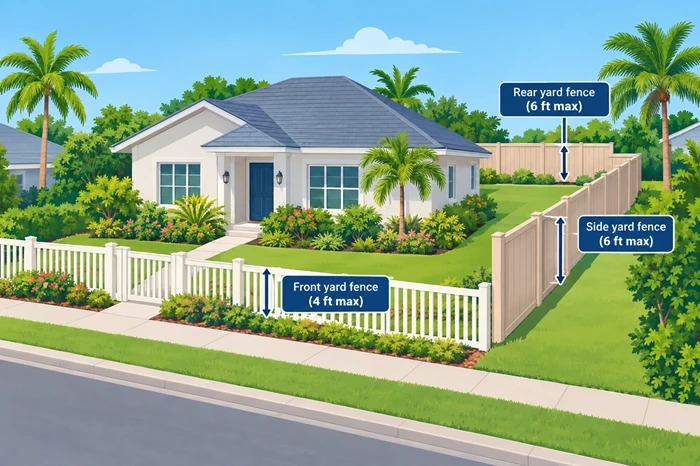
Planning a new fence, one of the first things to check is the front yard fence height allowed on your property. In unincorporated Palm Beach County, residential fencing is generally limited to 4 feet within the required front setback, while fences in required side, side-street, and rear setbacks can generally reach 6 feet. The County’s current Unified Land Development Code (ULDC) also contains specific exceptions, so your zoning district and property layout matter.
Before choosing a material or ordering panels, it is worth confirming exactly where your required setback begins, whether your property is in unincorporated county jurisdiction, and whether a special exception applies.
Key Takeaways
- Front yard fence height is generally limited to 4 feet in the required residential front setback.
- Side, side-street, and rear residential setbacks generally allow fences up to 6 feet.
- AR/RSA zoning can have a special exception for certain rail fences in the front setback.
- Municipalities inside Palm Beach County may have different rules, so verify the jurisdiction before building.
What Is the Maximum Front Fence Height in Palm Beach County?
For a typical residential property governed by Palm Beach County’s ULDC, the front yard fence height limit is 4 feet when the fence is located within the required front setback. The same standard applies to walls located in that area.
This rule is important because homeowners sometimes assume that a 6-foot privacy fence is automatically permitted simply because 6-foot fencing is common in backyards.
It is not that simple.
The County generally permits up to 6 feet in the required side, side-street, and rear setbacks. Landscape buffers can also have a 6-foot maximum under the residential standard.
That means the location of the fence on your lot can be just as important as the fence material.
If your goal is curb appeal rather than complete privacy, a shorter decorative fence can often provide an attractive boundary without creating a zoning problem.
Why the Required Setback Matters
The phrase front yard fence height can be misleading because the County’s rule is tied to the required front setback, not simply the area you personally consider your front yard.
A property’s zoning designation, lot configuration, building placement, and recorded site information can affect where the required setback begins.
For example, a fence that is 4 feet tall may comply when placed in the required front setback, while a 6-foot fence may become permissible farther toward the side or rear of the property.
Before construction, determine the applicable setback instead of measuring from the house and assuming that everything in front of it has the same restriction.
This is also why professional planning can save homeowners from having to modify or remove a newly installed fence.
Does a Privacy Fence Have a Different Height Limit?
A common misconception is that the County provides a separate, taller allowance simply because a homeowner wants privacy.
Generally, the front yard fence height restriction still applies to a residential fence or wall located within the required front setback. A fence does not automatically become exempt because it is made from wood, vinyl, aluminum, or another material.
For homeowners who want privacy, one practical approach is to use landscaping, architectural features, or a combination of permitted fencing and planting.
The County also regulates hedges separately. Current County code-compliance materials state that residential hedges in the required front setback are generally limited to 4 feet, with different limits applying to side and rear areas.
That distinction matters when designing a privacy-focused landscape.
What About Fence Height on the Sides and Rear?
The front yard fence height limit should not be confused with the maximum permitted height elsewhere on a residential property.
Under the County’s residential standards, fences and walls can generally reach 6 feet within required side, side-street, and rear setbacks. Landscape buffers can also have a 6-foot maximum.
This creates more flexibility for homeowners who want privacy around patios, pools, outdoor living spaces, or backyards.
A common design strategy is therefore to use a lower decorative fence toward the street and transition to taller screening along the sides or rear where permitted.
However, the transition must still comply with setback, sight-distance, easement, and other applicable requirements.
Choosing the Right Fence for Your Property
Once you understand the front yard fence height, you can focus on material, appearance, maintenance, and durability.
Working with a professional fence contractor can help evaluate your property and recommend a design that fits your goals.
Wood Fencing
Wood remains popular because it provides a traditional appearance and can work well with tropical landscaping.
Before choosing it, homeowners should consider maintenance, moisture exposure, insects, staining, painting, and long-term durability. Reviewing the wood fencing pros and cons in South Florida can help you decide whether it fits your property.
Aluminum and Vinyl
Aluminum can create a clean, open appearance while requiring relatively little maintenance. Vinyl can provide privacy and does not require the same type of routine painting or staining as wood.
While comparing materials, it is useful to compare aluminum vs. vinyl fencing before making a final decision.
Material selection, however, does not change the applicable zoning height.
How Fence Posts and Installation Affect the Project
Fence height is only one part of a successful installation.
The spacing between posts affects stability, appearance, and resistance to wind. A professional installer should account for the selected material, panel dimensions, soil conditions, and local weather exposure.
With a plan for new installation, reviewing the correct fence post spacing for South Florida homes can help you understand why post layout matters.
South Florida soil also deserves special attention.
Sandy soil can behave differently from compacted soils found elsewhere, so post depth should be determined based on the fence design and site conditions. If you are installing vinyl, learn more about how deep to set fence posts in sandy South Florida soil before construction begins.
Should Your Fence Be Designed for Hurricanes?
A compliant fence should also be designed with South Florida weather in mind.
Strong winds can put considerable pressure on fence panels, posts, gates, and connections. A taller, solid fence can experience greater wind loading than an open-style design.
That makes construction quality especially important even when the proposed front yard fence height is within the legal limit.
For additional planning guidance, review how to make your fence hurricane-ready.
A strong installation starts with appropriate posts and footings and continues with properly selected fasteners, hardware, gates, and panels.
What Are the Exceptions to the Standard?
The standard front yard fence height is not the only rule that exists in Palm Beach County.
The ULDC identifies an exception for property owned by Palm Beach County for preservation or conservation purposes, where a fence within the required front setback may reach 6 feet.
There is also a special provision involving rail fences in AR/RSA zoning districts. Recent County code-compliance records identify that certain rail fences in the required front setback may reach 6 feet.
These exceptions should not be assumed to apply to an ordinary residential lot.
Your zoning district and the specific characteristics of your property should be confirmed before relying on an exception.
What About Corner Lots?
Corner properties require extra care.
Even if your proposed front yard fence height complies with the normal residential standard, sight-distance requirements can affect what you are allowed to construct near an intersection or driveway.
The purpose is straightforward: drivers and pedestrians need adequate visibility at intersections.
A fence that blocks visibility can create a safety issue even when its overall height appears acceptable.
If your property is located on a corner, have the fence layout reviewed before installation rather than treating the entire property as subject to one simple height measurement.
What About Palm Beach County Cities?
One of the most important details homeowners should understand is that Palm Beach County can refer to either the county government area or the broader geographic county containing multiple municipalities.
The County’s ULDC applies to properties within its jurisdiction, but incorporated cities may have their own zoning codes and fence regulations. Palm Beach County itself directs users to its ULDC for zoning regulations in unincorporated areas.
For example, a homeowner inside a municipality should not automatically assume that the county’s 4-foot rule is the only applicable regulation.
Before construction, identify whether your property falls under county or municipal zoning authority and check the applicable code.
Common Mistakes Homeowners Make
One of the biggest mistakes is ordering a standard 6-foot privacy fence and discovering afterward that it extends into a restricted area.
Another is measuring the height from the wrong point.
Palm Beach County’s ULDC provides specific rules for measuring fence and wall height, including situations involving berms and grade changes. The code generally measures from the lowest grade adjacent to the fence unless a specific rule provides otherwise.
Homeowners can also overlook gates, walls, landscaping, easements, and corner visibility requirements.
A fence should therefore be planned as part of the complete site rather than treated as a standalone improvement.
How to Plan Your Fence Before Installation
Start by identifying your property’s jurisdiction and zoning district.
Next, determine the required front setback and identify exactly where the fence will sit. Then decide whether you want an open decorative design, partial screening, or a more private enclosure.
At this stage, the front yard fence height should be treated as a zoning requirement rather than simply a design preference.
After that, choose your material and confirm post spacing, footing requirements, gate locations, drainage considerations, and wind resistance.
If there is any uncertainty, check the current County ULDC or contact the appropriate zoning office before purchasing materials. Palm Beach County maintains its current ULDC resources online, and the County notes that ordinances can be updated through supplements and amendments.
Front Yard Landscaping and Fence Design
A lower fence does not mean you have to sacrifice curb appeal.
Thoughtful front yard landscaping can make a shorter fence feel intentional and polished. Consider ornamental grasses, palms, shrubs, flowering plants, pathway lighting, and a carefully designed entry gate.
For additional front yard landscaping ideas, focus on layering rather than simply adding more plants.
A good design might combine a permitted fence with low plantings near the street, taller landscaping farther back, and an attractive walkway leading to the entrance.
This approach can create privacy and visual separation without relying entirely on fence height.
How High Should a Privacy Fence Be?
The appropriate privacy fence height depends on where the fence is located and what you want it to accomplish.
A 4-foot fence may work well for defining the property boundary and improving curb appeal, but it will not provide the same visual screening as a taller enclosure.
For greater privacy, homeowners may be able to use taller fencing in permitted side and rear locations while keeping the street-facing section lower.
The key is designing the entire property around the applicable zoning limits rather than trying to make one fence height work everywhere.
Understanding the Front Yard Fence Height Limit
The front yard fence height limit is easiest to understand when you separate the property into different zoning areas.
For a typical residential property under the County’s ULDC:
- Required front setback: generally 4 feet.
- Required side setback: generally 6 feet.
- Required side-street setback: generally 6 feet.
- Required rear setback: generally 6 feet.
- Landscape buffer: generally 6 feet.
- Certain exceptions can apply depending on zoning and property ownership.
This simple breakdown can help you plan, but it should not replace checking the specific requirements for your lot.
Final Thoughts
Understanding the front yard fence height before buying materials can save you time, money, and frustration. For most residential properties under Palm Beach County’s unincorporated zoning rules, the required front setback has a 4-foot maximum, while many side and rear areas allow up to 6 feet.
The best approach is to verify your jurisdiction, zoning district, setbacks, property lines, and any special conditions before construction.
Once those details are confirmed, you can choose a fence that balances appearance, privacy, durability, hurricane resistance, and long-term maintenance.
FAQs
1. What is the standard front yard fence height in Palm Beach County?
The standard maximum is generally 4 feet within the required residential front setback.
2. Can a residential fence be 6 feet tall in Palm Beach County?
Generally yes in required side, side-street, and rear setbacks, subject to applicable regulations.
3. Does the same fence height apply throughout the property?
No, different setback areas can have different maximum heights.
4. Do Palm Beach County cities follow the County’s fence rules?
Not necessarily, because incorporated municipalities can have their own zoning regulations.
5. Should I verify fence requirements before installation?
Yes, confirming the current zoning and setback requirements before construction can prevent costly compliance problems.