

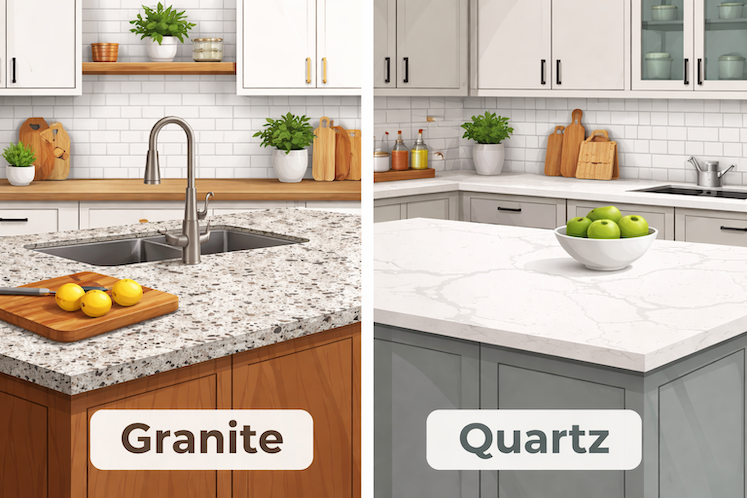
Choosing the right countertop is one of the most important decisions in any kitchen renovation. It’s not just about looks—it’s about durability, maintenance, cost, and how well it fits your lifestyle. If you’re deciding between granite and quartz countertops, you’re not alone. These two materials dominate modern kitchen design for a reason.
In this guide, we’ll break down everything you need to know about granite vs quartz countertops—from appearance and performance to cost and long-term value—so you can confidently choose the best option for your home.
Understanding Granite Countertops
Granite is a natural stone formed deep within the earth. Each slab is unique, with its own patterns, colors, and mineral variations.
Why Homeowners Love Granite
Granite has long been a favorite for homeowners who want a natural, high-end look.
Natural Beauty
No two granite slabs are identical. This uniqueness gives your kitchen a one-of-a-kind appearance that’s hard to replicate with other materials.
Heat Resistance
Granite handles heat extremely well. You can place hot pots directly on the surface without worrying about damage.
Strong and Durable
When properly sealed, granite is incredibly durable and resistant to scratches.
Potential Drawbacks of Granite
Despite its strengths, granite does come with a few considerations.
Requires Maintenance
Granite needs periodic sealing to prevent stains and bacteria from penetrating the surface.
Can Be Porous
If not sealed properly, it can absorb liquids, leading to staining.
Limited Color Consistency
Because it’s natural, you may find variations that don’t perfectly match your design expectations.
Understanding Quartz Countertops
Quartz countertops are engineered stone surfaces made from crushed quartz combined with resin and pigments.
Why Quartz Is So Popular
Quartz has surged in popularity thanks to its modern appeal and low maintenance.
Non-Porous Surface
Quartz doesn’t require sealing. It resists stains, bacteria, and moisture naturally.
Consistent Appearance
Because it’s engineered, quartz offers uniform patterns and colors—ideal for sleek, modern kitchens.
Low Maintenance
Cleaning quartz is simple. Mild soap and water are usually enough.
Potential Drawbacks of Quartz
Quartz is impressive, but it’s not perfect.
Less Heat Resistant
Unlike granite, quartz can be damaged by high heat. Trivets are recommended for hot cookware.
Slightly Higher Cost
Quartz can sometimes cost more upfront, depending on the brand and style.
Not Fully Natural
For homeowners who want 100% natural materials, quartz may feel less authentic.
Granite vs Quartz: Side-by-Side Comparison
Let’s break it down clearly so you can see how they stack up.
Appearance
-
Granite: Natural, unique patterns with variation
-
Quartz: Uniform, customizable designs
If you want something organic and one-of-a-kind, granite stands out. For a clean, modern aesthetic, quartz is the better choice.
For more design inspiration, it helps to explore the differences between modern and traditional kitchen styles—especially when deciding which countertop material will suit your space best.
Durability
-
Granite: Extremely durable but requires sealing
-
Quartz: Highly durable and non-porous
Both materials are tough, but quartz wins in terms of everyday convenience.
Maintenance
-
Granite: Needs sealing once or twice a year
-
Quartz: Virtually maintenance-free
If you want a worry-free surface, quartz is hard to beat.
Heat Resistance
-
Granite: Excellent heat resistance
-
Quartz: Sensitive to high heat
Granite is the better choice if you frequently cook with high temperatures.
Cost
Costs vary based on quality, thickness, and installation, but both fall into a similar price range.
To get a clearer picture of pricing, it’s worth looking at a detailed kitchen renovation cost breakdown that many homeowners use when planning their budget.
Which Countertop Is Best for Your Lifestyle?
The “best” choice depends on how you use your kitchen.
Choose Granite If You:
-
Love natural stone and unique patterns
-
Cook frequently with high heat
-
Don’t mind occasional maintenance
-
Want a classic, timeless look
Choose Quartz If You:
-
Prefer low maintenance and easy cleaning
-
Want a consistent, modern appearance
-
Need a stain-resistant surface
-
Have a busy household
Design Considerations That Matter
Your countertop choice should also complement other kitchen elements.
Matching Your Backsplash
Your countertop and backsplash should complement each other visually, and if you’re unsure how to match them, learning how to choose the perfect kitchen backsplash can help you create a more cohesive design.
Cabinet Pairing
-
Granite pairs well with wood cabinets and traditional styles
-
Quartz works beautifully with flat-panel cabinets and modern designs
Lighting Impact
Quartz reflects light more evenly due to its uniform surface, while granite creates depth with its natural variations.
Long-Term Value and ROI
Both granite and quartz can increase your home’s value, especially in competitive real estate markets.
Quartz tends to appeal more to modern buyers due to its low maintenance, while granite attracts those who appreciate natural materials.
If you want to refresh your kitchen without stretching your budget, it’s worth exploring some of the cheapest ways to make your kitchen look new before committing to a full renovation.
Common Mistakes to Avoid
Choosing the wrong countertop can lead to regret. Here are a few mistakes to watch out for:
Ignoring Your Lifestyle
A high-maintenance surface may not suit a busy household.
Choosing Based on Looks Alone
Functionality is just as important as aesthetics.
Not Seeing Full Slabs
Always view full slabs before deciding—especially with granite.
Skipping Professional Advice
Expert guidance can save you from costly mistakes.
Final Thoughts: Granite or Quartz?
There’s no universal winner in the granite vs quartz debate—it all comes down to your priorities.
If you value natural beauty and heat resistance, granite is a strong contender. If you prefer low maintenance and a modern look, quartz is likely the better fit.
Ultimately, your countertop should enhance both the function and style of your kitchen. If you’re planning a full renovation, getting expert guidance can make the entire process smoother and more efficient.
Get A Free Estimate to explore your options and choose the best solution for your space.