
Most homeowners think about doors and windows one piece at a time — replacing a cracked pane here, swapping an ageing front door there. The better approach is to treat them as a system. The selections you make affect natural light, indoor temperature, security, street presence, and the overall finish quality of the property all at once.
In South Florida, you also have a layer most other states do not: hurricane codes. Getting the combination right means your home looks better, functions better, and holds up when it needs to.
What You Are Actually Choosing
A door or window is not just the unit itself. Every selection involves:
- Frame material — aluminium, vinyl, fiberglass, or wood composite, each with different durability, maintenance, and thermal performance profiles
- Glass type — single pane, double pane, laminated impact glass, or Low-E coatings for heat rejection
- Hardware and locking systems — multi-point locks on entry doors and reinforced frames on windows change the security profile significantly
- Profile and colour — the exterior look affects kerb appeal; the interior trim and sill depth affect how a room feels and reads visually
Getting any one of those wrong costs you on the others. A beautiful entry door on an undersized frame looks off. High-performance glass in a poorly sealed frame loses half its thermal benefit.
Natural Light and Sightlines
Changing window size or configuration is one of the most effective ways to alter how a room feels without touching the layout. A bedroom with two small louvred windows becomes a different space with a wider double-hung or a casement unit that opens the wall.
Sightlines matter too. If your living room window frames a neighbour’s fence rather than the garden, repositioning or sizing up the opening during a renovation moves the focal point without structural complexity in most single-storey homes.
For rooms that feel permanently dim — interior-facing bedrooms, narrow hallways, galley kitchens — consider whether the window is undersized, poorly placed, or blocked by outdated tinting. In many cases, the fix is straightforward.
Security Starts with the Frame, Not Just the Lock
A high-quality deadbolt on a hollow-core door or a flimsy aluminium frame provides little real protection. The weakest point is usually where the door meets the frame or where the window sash meets the track.
Impact-rated doors and windows address this differently. The laminated glass resists penetration rather than simply shattering. Multi-point locking systems engage the frame at several points rather than a single latch. Combined, they raise the effort required to force entry substantially.
For Florida homeowners, this matters year-round — not only during hurricane season.
The Hurricane Code Reality in Broward County
Florida’s building code requires impact-rated or protected openings on homes in high-velocity hurricane zones. Broward County falls within these requirements, and local building departments enforce them on new installations and permitted replacements.
Impact glass meets that requirement without shutters or panels. You do not need to board up before a storm, and you keep natural light and views during a storm watch. That convenience compounds over time for homeowners who have previously dealt with the seasonal labour of installing shutters.
Impact doors versus hurricane shutters is a comparison worth reading if you are weighing both options — the cost picture and the day-to-day trade-offs differ more than most homeowners expect.
Energy Performance in South Florida’s Climate
Heat gain through glass is a significant driver of air-conditioning costs in South Florida. Standard clear glass transmits most of the solar energy that hits it. Low-E coatings are the primary way to cut solar heat gain through glass; impact-laminated glass adds some incremental benefit, and double-pane units with an insulating gas fill extend it further. Most quality impact windows in South Florida combine all three.
The combination of impact glass and a well-sealed, insulated frame can reduce the thermal load on rooms that run east or west — the orientations that receive the most intense direct low-angle sun during South Florida’s summer mornings and afternoons.
If your current windows have visible condensation between panes, feel warm to the touch on sunny afternoons, or date from a previous decade, the signs your Florida windows need replacing are usually clear once you know what to look for.
Entry Doors and Finish Level
The front door is the first piece of craftsmanship a visitor or buyer sees. An entry door in a style that conflicts with the home’s architecture — or one that has faded, warped, or developed frame gaps — lowers the perceived quality of everything around it, regardless of what else has been updated.
Signature and decorative impact entry doors are available in configurations that handle Florida’s codes without looking utilitarian. Sidelights, transoms, and decorative glass inserts are all compatible with impact-rated construction. The practical and the aesthetic are not in conflict here.
For homeowners working on a broader exterior update — driveway, fencing, façade — the entry door is usually worth addressing in the same project scope rather than as a separate trip.
Insurance Implications
Impact-rated openings can qualify a property for insurance discounts in Florida — windstorm premium reductions of 10–45% are documented depending on the insurer and how many openings are protected. It is worth requesting a Wind Mitigation Inspection after installation, as this documents the upgrades formally and gives insurers the evidence needed to adjust your premium.
How impact doors affect South Florida insurance costs covers what the inspection process involves and what discount categories typically apply.
Choosing Between Window Types
Not every window type suits every application. A few practical distinctions for Florida homes:
- Casement windows open fully on one side and provide good ventilation — useful in rooms where airflow matters
- Double-hung windows slide vertically and are easier to clean from inside — common in bedrooms and secondary rooms
- Fixed picture windows do not open but maximise glass area for light and views — good for focal walls or living areas where ventilation comes from another source
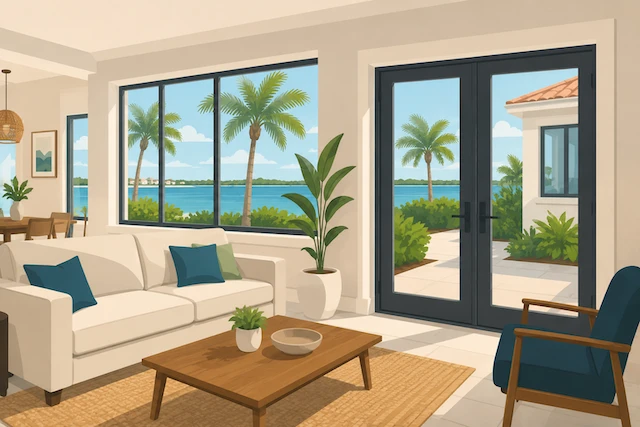
- Sliding glass doors bridge interior and exterior in Florida’s climate and are available in impact-rated configurations for pool areas and rear-access rooms
Vinyl versus fiberglass windows for South Florida homes is a useful comparison if you are deciding between those two frame materials specifically — both are common in the region and each has clear trade-offs.
What a Coordinated Installation Looks Like
Replacing doors and windows across a home — or even across a single façade — in a single project produces a cleaner result than piecemeal work over several years. Frame colours and profiles match. The installation crew works through the permit process once rather than repeatedly. Trim details and exterior finishes are addressed as a unit.
If your project also includes driveway work, fencing, or interior remodelling, Top Renovations handles multiple renovation scopes under a single contractor — which removes the coordination burden and keeps your timeline from fragmenting across separate teams.
Getting an Estimate
The cost of a doors-and-windows project depends on the number of openings, the product lines selected, whether structural modifications are needed, and the permit requirements for your specific Broward County location.
The starting point is an on-site assessment that gives you accurate measurements and product options matched to your home’s architecture and code requirements.
Call (954) 237-4257 or get an estimate to get a clear picture of scope and cost before committing to anything.