

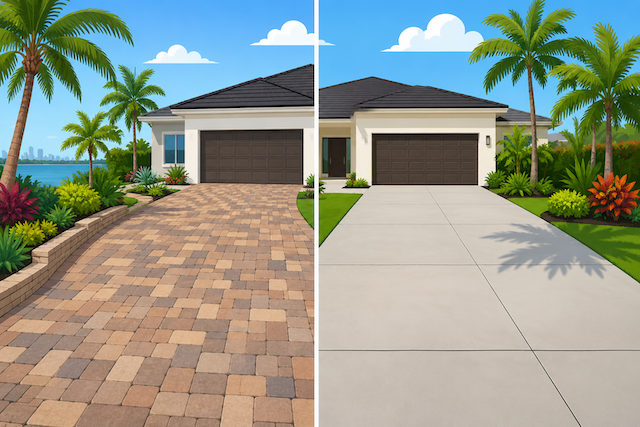
If you’re researching a pavers vs concrete driveway in South Florida, you’re facing one of the most common — and consequential — decisions in a driveway project: Concrete costs less upfront and installs faster. Pavers offer easier repairs, better curb appeal, and more flexibility over time. In South Florida’s heat, humidity, and storm conditions, both materials can work — but only when installed correctly.
Key Takeaways
- Paver driveways in South Florida typically cost $15 to $25 per square foot installed, compared to $8 to $14 per square foot for standard concrete — though prices vary by contractor, material availability, and market conditions, so always get current local quotes.
- Concrete is faster to install but more prone to cracking as South Florida’s soils — a mix of limestone, sand, and in some areas clay — shift during wet and dry cycles.
- Pavers allow individual unit replacement, which makes storm damage and tree root repairs significantly cheaper than full concrete resurfacing.
- Both materials require a properly compacted base layer — skipping this step is the leading cause of premature failure in South Florida driveways.
- Permeable paver systems may help South Florida homeowners address local stormwater management requirements in some municipalities and can reduce flood risk on their property — though specific requirements vary by city and county.
- Concrete driveways can absorb and radiate intense heat; light-colored or brushed-finish pavers stay measurably cooler underfoot in peak summer months.
Pavers vs. Concrete Driveway Cost in South Florida: What Should You Expect to Pay?
The upfront price gap between pavers and concrete is real but narrower than most homeowners expect once long-term maintenance is factored in.
For a standard two-car driveway of roughly 400 to 600 square feet in South Florida, a basic broom-finish concrete installation typically runs between $3,200 and $8,400 based on the per-square-foot ranges above — though current contractor pricing in your area may vary. A comparable paver driveway — using concrete pavers, which are among the most widely used options in the region — typically runs $6,000 to $15,000 for the same footprint at those same rates.
Stamped or decorative concrete closes that gap considerably. A stamped concrete driveway can typically run $12 to $18 per square foot or more depending on design complexity and current South Florida market rates, overlapping directly with mid-range paver pricing. At that point, the choice shifts from cost to performance.
Where Concrete Saves Money Long-Term
Concrete has lower upfront labor costs because it pours and sets in a single continuous process. There are no individual units to lay, level, and compact. For a straightforward rectangular driveway with no curves or design features, concrete is genuinely faster and cheaper.
Sealing costs are also lower. A concrete driveway sealed every two to three years typically adds roughly $200 to $400 per treatment for a standard two-car driveway, though current South Florida contractor rates will vary.
Where Pavers Save Money Long-Term
The repair math strongly favors pavers. If a tree root heaves a section of concrete driveway, repair can range from partial section replacement to full resurfacing depending on the extent of the damage — a cost that can reach $3,000 to $6,000 or more in many cases. With pavers, a contractor lifts the affected units, addresses the root or soil issue, and re-lays the same pavers. That repair is generally far less expensive, though current South Florida contractor rates apply.
Industry sources, including the Interlocking Concrete Pavement Institute — which represents the paver industry and should be read with that context in mind — suggest properly installed interlocking concrete paver systems can last 25 to 50 years with routine maintenance. Independent experience in variable-climate regions supports the general view that well-installed pavers can match or exceed the lifespan of poured concrete, though outcomes depend heavily on site conditions and installation quality.
How Does South Florida’s Climate Affect Each Material?
South Florida’s climate is one of the most demanding in the continental United States for any hardscape material. Temperatures exceed 90°F for months at a time, annual rainfall is among the highest in the continental U.S. — NOAA data for the Miami area consistently shows totals in the range of 60 to 65 inches per year — hurricane-force winds are a documented risk, and the region’s limestone and sandy soils, with clay content varying by location, can shift with moisture changes.
Concrete in South Florida Conditions
Poured concrete is rigid. It cannot flex. When the soil beneath it shifts — as it does every wet season — cracks form. On sites with poor drainage or problematic soils, premature cracking can occur significantly earlier than the material’s rated lifespan — in some cases within a decade.
Heat absorption is a separate issue. Studies on urban heat islands suggest that concrete and paved surfaces can reach surface temperatures well above ambient air temperature on a summer afternoon — commonly cited figures range from around 120°F to 160°F depending on color, finish, and sun exposure. That is uncomfortable underfoot and contributes to the urban heat island effect around the home.
Salt air corrosion is a real factor for coastal properties — research generally identifies the highest risk within roughly a mile of the ocean, with diminishing but still present effects at greater distances depending on prevailing winds and site exposure. Salt penetrates concrete over time and corrodes the steel rebar used in reinforced slabs, causing spalling and structural weakening. Proper sealers and low water-cement ratios slow this process but do not eliminate it.
Pavers in South Florida Conditions
Interlocking pavers handle soil movement far better than concrete because each unit can shift slightly without the surface failing catastrophically. The jointing sand between units acts as a flexible buffer, accommodating minor ground movement and tree root pressure.
Permeable paver systems, covered in detail in our Florida permeable driveways guide, go further by allowing rainfall to pass through the surface and infiltrate the ground below. This can help reduce surface runoff during the intense rain events South Florida experiences throughout hurricane season, and in some municipalities may support compliance with local stormwater requirements — though homeowners should confirm applicable rules with their local building department.
Pavers do absorb heat, but lighter-colored units — travertine, tan concrete pavers, or white-washed finishes — reflect significantly more solar radiation than gray concrete. Our post on travertine pavers for cool front yards in Boca Raton covers the thermal performance difference in detail.
Which Material Holds Up Better in Hurricanes?
Hurricane performance is a legitimate concern for any exterior surface in South Florida, and the answer here is more nuanced than most contractors will tell you.
Neither pavers nor concrete provides meaningful structural resistance to direct hurricane wind loading on a horizontal driveway surface — wind damage to driveways is almost always from debris impact, flooding, or storm surge, not wind uplift. Both materials resist debris impact well when installed at the correct thickness.
Where the materials diverge is post-storm recovery. After a hurricane event, a concrete driveway with cracks, heaving, or surface damage typically requires demolition and repour — a slow, expensive process especially when contractor demand spikes after a major storm. A paver driveway with displaced or broken units can often be repaired within days using units from the same batch or a matched replacement, even when contractor availability is tight.
Flooding is the more relevant threat. Impermeable concrete driveway surfaces increase surface runoff during storm events, which can direct water toward your home’s foundation. Permeable paver systems actively mitigate this. According to the South Florida Water Management District, impervious surfaces are a primary driver of urban flooding across the region, which is why several South Florida municipalities now offer incentives or impose requirements for permeable hardscaping on residential properties.
Aesthetics and Curb Appeal: Which Looks Better?
This is genuinely subjective, but market data tells a clear story.
Pavers consistently score higher in curb appeal surveys and real estate appraisals because they offer color variation, pattern options (herringbone, running bond, basketweave), and a high-end appearance that reads well in listing photography. For homes in upscale South Florida neighborhoods — Boca Raton, Coral Gables, Delray Beach, Weston — a paver driveway is close to the standard expectation.
Stamped concrete can replicate the look of pavers or stone at lower cost, but the grout lines are surface-printed rather than structural, and as the slab ages and cracks, the aesthetic illusion breaks down.
Plain broom-finish concrete reads as functional rather than decorative. It performs its job, but it does not add meaningful curb appeal relative to pavers at the same investment level.
For homeowners planning to sell within the next five years, the curb appeal premium of pavers is worth weighing seriously. Our breakdown of renovation projects that boost South Florida home value covers where driveway upgrades sit in the overall ROI picture.
What About Maintenance Requirements?
| Factor | Concrete Driveway | Paver Driveway |
|---|---|---|
| Sealing frequency | Every 2–3 years | Every 3–5 years |
| Crack repair | Full section resurfacing | Individual unit replacement |
| Weed growth | Minimal (single surface) | Possible in joints (manageable) |
| Stain removal | Moderate difficulty | Moderate difficulty |
| Average lifespan | 25–30 years (with care) | 30–50 years (with care) |
| Storm damage repair | High cost, slow | Lower cost, faster |
Weed growth in paver joints is the most common maintenance complaint. Polymeric sand — the jointing material used by professional installers — contains binders that harden when wet and significantly reduce weed germination and ant activity. Our guide on why unsealed pavers attract mold, ants, and weeds explains this in full and covers the sealing schedule that prevents most of these issues.
Do You Need a Permit for Either Type in South Florida?
Yes — in most South Florida municipalities, any driveway installation or significant replacement requires a permit, regardless of material. This applies across Miami-Dade, Broward, and Palm Beach counties, though the specific requirements vary by city.
Permit requirements typically cover the total impervious surface area added to the lot, drainage plans, and setback compliance. Exceeding permitted impervious coverage without approval can result in fines and mandatory removal. Our post on whether you need a permit to extend a driveway in South Florida walks through the permit process in detail.
A licensed contractor familiar with local codes will handle permitting as part of the project — this is one of the clearest reasons to avoid DIY driveway installation on any project above minor repairs.
Which Should You Choose?
The honest answer depends on four variables: budget, timeline, aesthetic goals, and how long you intend to stay in the home.
Choose concrete if you need the lowest possible installation cost, your timeline is tight, and you are not prioritizing premium curb appeal. Concrete is also the stronger choice if your site has a perfectly level, stable subgrade with no significant tree root risk.
Choose pavers if curb appeal matters, if you have trees near the driveway, if your site has drainage challenges that a permeable system would address, or if you plan to stay in the home long enough for the lower repair costs to offset the higher installation price. For most South Florida homeowners in that position, pavers deliver better total value over a 15-plus-year horizon.
Either way, the single most important factor is subbase preparation. A paver or concrete driveway on a poorly compacted, inadequately drained base will fail faster than any material difference can compensate for. Use a licensed contractor, verify the base depth and compaction spec before installation begins, and get the work permitted.
Frequently Asked Questions
How long do paver driveways last in South Florida?
Properly installed interlocking concrete paver driveways typically last 30 to 50 years in South Florida conditions. Lifespan depends heavily on subbase preparation, the quality of jointing sand used, and whether the surface is sealed on a regular schedule. Travertine and natural stone pavers can last even longer but require more careful maintenance against salt air and staining.
Is concrete or pavers better for resale value in South Florida?
Pavers generally add more resale value and curb appeal than plain concrete driveways in South Florida’s competitive real estate market. In higher-end neighborhoods across Broward and Palm Beach counties, a paver driveway is often an expected feature rather than an upgrade. Stamped concrete offers a middle ground, but its aesthetic advantage diminishes as the slab ages and surface cracks develop.
Do pavers get hotter than concrete in Florida summers?
Both materials absorb significant heat in South Florida’s summer sun, but the outcome depends on color and finish more than material type. Light-colored pavers — particularly travertine and tan concrete pavers — stay noticeably cooler than standard gray concrete slabs. Dark or charcoal-toned pavers can be as hot or hotter than concrete. Surface texture also matters: rougher or matte finishes reflect more radiation than smooth, polished surfaces.
Can I install pavers over an existing concrete driveway in South Florida?
In many cases, yes — pavers can be installed over an existing concrete slab if the slab is structurally sound and relatively level. This eliminates demolition costs but requires careful assessment of drainage and height changes at transitions. If the existing concrete is significantly cracked, heaved, or poorly drained, full removal is the better approach. A professional site evaluation is essential before committing to an overlay installation.
How much does a paver driveway cost compared to concrete in South Florida?
A standard concrete driveway in South Florida runs approximately $8 to $14 per square foot installed. A concrete paver driveway runs $15 to $25 per square foot for most residential projects, with natural stone pavers reaching $25 to $40 per square foot. For a 500-square-foot two-car driveway, that represents a rough cost of $4,000 to $7,000 for concrete versus $7,500 to $12,500 for standard pavers.
Do I need a permit to replace my driveway in South Florida?
Most South Florida municipalities require a permit for full driveway replacement or significant extension, including both concrete and paver installations. Requirements cover drainage compliance, impervious surface limits, and setbacks. Working with a licensed contractor who pulls permits as part of the project protects you from fines and ensures the work meets local building codes.
Choosing between pavers and concrete comes down to your priorities, your site conditions, and your timeline for return on investment. If you want a professional assessment of which material suits your specific property, contact Top Renovations for a free estimate — our team has installed both systems across Miami-Dade, Broward, and Palm Beach counties and can walk you through the options that make sense for your home.