
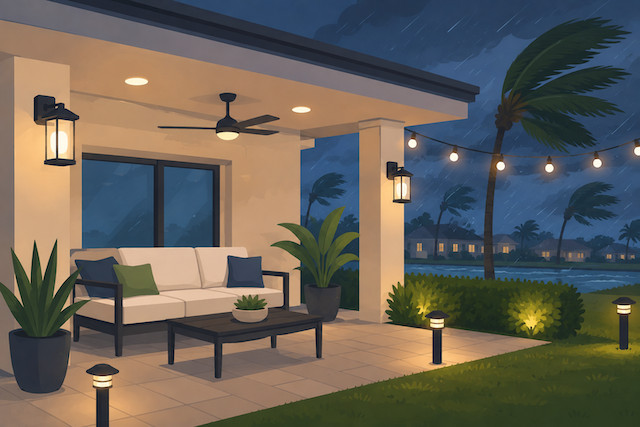
The best hurricane-resistant outdoor lighting for South Florida patios uses wet-rated, corrosion-resistant fixtures made from marine-grade stainless steel, powder-coated aluminium, or brass, sealed to an IP65 or higher standard. Wind ratings should meet or exceed the requirements of your local building code for your area. Low-voltage LED systems and hardwired fixtures anchored into concrete or masonry hold up far better than solar stake lights, which fail quickly in storm conditions.
Key Takeaways
- Hurricane-resistant patio lighting requires wet-rated fixtures (IP65 or higher) built from marine-grade stainless steel, brass, or powder-coated aluminium to survive salt air and driving rain.
- Florida experiences frequent hurricanes, making storm-rated fixtures a practical necessity, not a luxury.
- Low-voltage LED landscape lighting and hardwired fixtures anchored into concrete outperform solar stake lights, which corrode and dislodge quickly in South Florida storms.
- Fixtures should be mounted flush or recessed where possible, with any removable elements designed to come down fast before a named storm arrives.
- The National Electrical Code (NEC) requires GFCI protection on all outdoor patio circuits, and a licensed electrician should handle hardwired installations.
Why Standard Outdoor Lighting Fails in South Florida
South Florida combines three punishing conditions: hurricane-force winds, salt-laden air, and near-constant humidity. Standard big-box outdoor fixtures are rarely built for all three at once.
What actually happens is this — a cheap solar stake light might glow for a season, then the plastic housing cracks, the battery corrodes, and the first tropical storm rips it out of the ground. We see it constantly across Broward and Miami-Dade patios.
Salt air is the quiet killer. Even 10 miles inland, coastal moisture accelerates rust on unsealed steel and eats through low-grade aluminium. A fixture that lasts a decade in Ohio might last two years here.
If you want the background on why storm damage hits some outdoor products harder, our piece on why South Florida storms damage solar stake lights faster breaks down the exact failure points.
What Makes a Patio Light Hurricane-Resistant?
A hurricane-resistant patio light is a wet-rated, corrosion-proof fixture that is physically anchored to withstand high winds and sealed against water intrusion. Three specifications matter most: material, wind rating, and ingress protection (IP) rating.
Material selection
Not all metals survive coastal Florida. Here is how the common options compare.
| Material | Salt Resistance | Expected Durability Near Coast | Cost |
|---|---|---|---|
| Marine-grade 316 stainless steel | Excellent | Generally longer-lasting; performance varies with maintenance | High |
| Solid brass | Excellent (patinas naturally) | Generally longer-lasting; performance varies with maintenance | High |
| Powder-coated aluminium | Good | Moderate lifespan; coating quality significantly affects durability | Moderate |
| Standard steel / cheap zinc | Poor | Shorter lifespan; corrosion occurs relatively quickly | Low |
For patios within a few miles of the Atlantic or Intracoastal, marine-grade 316 stainless or solid brass are the safest long-term bets.
Wind and impact ratings
Look for fixtures rated for high wind speeds. This is especially important in parts of South Florida designated as High-Velocity Hurricane Zones. Consult the current Florida Building Code and your local building department for specific wind load requirements and zoning classifications in your area. Wall-mounted and recessed fixtures with low surface area resist wind uplift best.
IP rating
The IP rating tells you how sealed a fixture is. For exposed patios, aim for IP65 minimum — dust-tight and protected against water jets. Submersible or heavily exposed areas call for IP67 or IP68.
Best Hurricane-Resistant Outdoor Lighting Types for Patios
The best outdoor lighting solutions for South Florida patios balance durability, safety, and ambience. Here are the fixture types that consistently perform.
- Recessed soffit and eave lighting — Mounted into the underside of your roof overhang, these are shielded from direct wind and rain, making them one of the most storm-durable options.
- Low-voltage LED landscape lighting — A 12-volt system with buried cable and brass path or well lights delivers ambience with minimal wind exposure.
- Hardwired wall sconces (flush-mount) — Anchored into concrete block or stucco walls, these resist uplift far better than protruding lantern styles.
- In-ground well lights — Set flush into the patio surface, they have virtually no wind profile and illuminate walls, palms, or columns beautifully.
- Ceiling-mounted covered patio fixtures — Under a screened or solid roof, wet-rated flush mounts and hurricane-rated ceiling fans with lights work well.
For patios under a covered structure, our guide on how to build a covered patio in South Florida pairs perfectly with a protected lighting plan.
Are Solar Patio Lights Worth It in South Florida?
Solar patio lights are generally a poor long-term choice for South Florida because their plastic housings degrade under intense UV, their batteries corrode in humidity, and stake-mounted units dislodge in high winds. They can work as temporary or decorative accents, but they should never be your primary patio lighting.
In practice, homeowners who install $30 solar path lights replace them every year or two. Over a decade, that cost exceeds a quality low-voltage LED system that never needs replacing.
There is also a safety angle worth weighing. A dislodged solar stake becomes airborne debris in high winds, and cracked housings expose lithium batteries to moisture. For a primary lighting layer that has to perform in storm season, the reliability gap between solar and a properly installed low-voltage system is simply too wide to ignore.
If you love the flexibility of solar, use it only for lightweight accent moments — and take those stakes down before any named storm.
How to Mount and Anchor Patio Lights for Storms
Proper anchoring is the difference between a fixture that survives a Category 3 and one that becomes a flying projectile. Follow this sequence.
- Mount into structure, not soil where possible — Concrete, masonry, and stucco hold fixtures far better than soft ground.
- Use stainless steel fasteners — Galvanised or zinc screws rust and fail; 316 stainless bolts and anchors last.
- Seal every penetration — Apply exterior-grade silicone around wall and soffit mounts to block water intrusion and rot.
- Bury low-voltage cable properly — Trench landscape wiring to code depth so it cannot be pulled up by wind or foot traffic.
- Plan for quick removal — Any string lights, hanging lanterns, or removable accents should come down within an hour before a storm.
The National Electrical Code (NEC) typically requires GFCI protection on wet locations and outdoor circuits. Consult your local building department and a licensed electrician to confirm current requirements and any exceptions for your jurisdiction. For any hardwired work, hire a licensed electrician — this is not a DIY shortcut.
Lighting Design Ideas That Survive Storms and Look Great
You do not have to trade beauty for durability. Layering different light types creates depth while keeping every fixture storm-smart.
- Wash your walls with recessed well lights for a soft, upscale glow with zero wind profile.
- Uplight palms and columns using buried brass fixtures to add drama safely.
- Line steps and paths with low-voltage path lights on buried cable rather than solar stakes.
- Layer soffit downlights under covered areas for even, functional task lighting.
Warm colour temperatures around 2700K to 3000K feel inviting and complement South Florida’s coastal palette. If you are rethinking your whole outdoor space, our outdoor renovation ideas to transform your backyard covers lighting alongside hardscaping and shade.
For a smart, layered approach to path and driveway safety, the ideas in our smart driveway lighting guide for safer South Florida homes apply directly to patios too.
Frequently Asked Questions
What IP rating do I need for outdoor patio lights in Florida?
For exposed South Florida patios, choose fixtures rated IP65 or higher, which are dust-tight and resistant to water jets. Areas near pools, fountains, or heavy splash zones should use IP67 or IP68 submersible-rated fixtures for full protection.
Will my patio lights survive a hurricane?
Properly chosen and anchored fixtures are far more likely to survive high winds, but no fixture is fully guaranteed in extreme storms. Recessed soffit lights, in-ground well lights, and flush wall mounts anchored into concrete with stainless fasteners typically perform best, while string lights and solar stakes should be removed before a storm.
Are LED or halogen lights better for coastal patios?
LED lights are the clear choice for coastal South Florida patios. They run cooler and use up to 80 percent less energy, according to the US Department of Energy. They also last far longer. Best of all, they come in sealed, corrosion-resistant marine-grade housings that halogen fixtures rarely match.
Do I need a permit or electrician for patio lighting?
Low-voltage plug-in landscape lighting usually needs no permit, but any new hardwired circuit or fixture typically requires a permit and a licensed electrician in Miami-Dade and Broward counties. See our outdoor renovation ideas for how permitted work fits into a larger project. Outdoor circuits typically require GFCI protection under the National Electrical Code; confirm current requirements with your local building department.
What is the most durable material for outdoor light fixtures in salt air?
Marine-grade 316 stainless steel and solid brass are the most durable materials for salt-air environments, routinely lasting 15 to 20 years or more. Powder-coated aluminium is a solid mid-range option, while standard steel and cheap zinc corrode within a few years near the coast.
Ready to Light Your Patio the Right Way
The smartest move for 2025 is a layered, low-voltage LED plan. Build it on marine-grade fixtures, anchor everything into structure, and design it so removable pieces come down fast before a storm. That combination gives you beauty, safety, and fixtures that last through hurricane season after hurricane season.
If you want a patio lighting design tailored to your home’s exposure and coastal distance, contact Top Renovations for a free estimate and we will map out a storm-ready plan.