

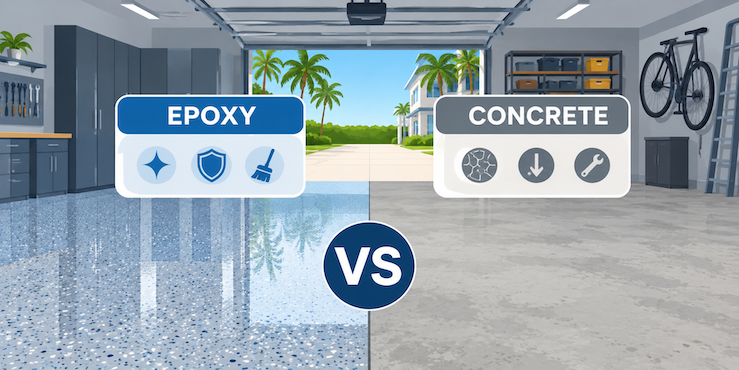
When weighing epoxy vs concrete flooring for South Florida garages, the choice has real consequences. Both surfaces are common, but they perform very differently under the region’s heat, humidity, and hurricane-season conditions. Epoxy coating delivers better durability, moisture resistance, and finish — but costs more upfront than leaving concrete unsealed.
Key Takeaways
- Epoxy flooring typically costs in the range of $3 to $7 per square foot installed in South Florida, compared to $1 to $3 per square foot for a basic concrete seal or resurfacing — though prices vary significantly by contractor, slab condition, and coating system, so obtaining local quotes is recommended.
- South Florida’s humidity and heat cause bare concrete to absorb moisture, leading to spalling, cracking, and surface degradation without protective treatment; in persistently damp conditions, mould and algae can also develop on or around porous uncoated surfaces.
- A properly installed epoxy coating can typically last 10 to 15 years or more in a garage environment when surface preparation is done correctly before application, though the upper end of that range depends on coating quality, use, and maintenance.
- Concrete without a coating remains the cheaper short-term option but generally requires more frequent maintenance and repair in Florida’s climate.
- Structural concrete repair — as opposed to surface coating — may require permits depending on your municipality in South Florida; requirements vary locally, so confirming with your local building department before beginning any slab repair work is advisable.
- Epoxy flooring is generally considered to add visual appeal and is often cited by real estate professionals as a positive factor for resale, particularly relevant in South Florida’s competitive residential property market.
What Is the Difference Between Epoxy and Bare Concrete Flooring?
Bare concrete is the structural slab itself — poured, cured, and left either unsealed or with a basic penetrating sealer. Epoxy flooring is a resinous coating system applied on top of that concrete slab, typically in two or more layers, that bonds chemically to the surface and cures into a hard, semi-gloss or high-gloss finish.
The distinction matters because many homeowners assume “epoxy floor” means a different type of floor. In reality, you always have a concrete slab underneath — the question is whether that slab is protected, enhanced, and coated with an epoxy system, or left exposed.
In South Florida garages, this choice has significant practical consequences because the regional climate stresses unprotected concrete in ways that are less common in drier, cooler parts of the country.
How Does South Florida’s Climate Affect Garage Flooring?
South Florida’s climate — defined by year-round heat, relative humidity that frequently exceeds 70% during much of the year, intense UV exposure, and seasonal heavy rainfall — creates specific failure modes for garage floors that homeowners in other regions rarely encounter.
Moisture infiltration is the primary threat to uncoated concrete slabs in this region. During humid months, moisture vapour rises through the slab from the ground below, a process called hydrostatic pressure or vapour transmission. This causes uncoated concrete to develop efflorescence (white mineral deposits), surface flaking, and over time, spalling — where chunks of the surface break away.
Thermal expansion and contraction is another factor. South Florida garages are frequently uninsulated and experience significant temperature swings between outdoor heat and air-conditioned spaces. Concrete expands and contracts with temperature changes, which gradually widens hairline cracks in uncoated slabs.
Oil and chemical staining is a practical concern in any garage environment. Bare concrete is highly porous, and vehicle oil, transmission fluid, and cleaning chemicals penetrate quickly and permanently without a sealed surface.
The Florida Building Code sets out requirements for concrete used in residential construction, including provisions specific to South Florida’s High-Velocity Hurricane Zone — but those standards are primarily concerned with structural performance, not surface durability or finish longevity. Confirm any applicable requirements with your local building authority.
Epoxy vs Concrete Flooring in South Florida Garages: Durability Comparison
Moisture Resistance
Epoxy coatings, when properly installed, create a non-porous surface that blocks moisture vapour transmission from above. However, the most critical factor is what happens beneath the coating. If a South Florida slab has high moisture vapour emission rates — common with older slabs or slabs without proper vapour barriers — an epoxy coating applied without moisture mitigation is likely to delaminate, bubble, and peel — often within a relatively short timeframe, which contractor experience in the region commonly puts at one to two years or less.
This is one of the most common epoxy failure points in South Florida garages, and it is almost always the result of inadequate surface preparation, not a failure of the epoxy product itself.
Uncoated concrete does not delaminate, but it absorbs and retains moisture continuously, degrading surface quality over years.
Impact and Abrasion Resistance
A 100% solids epoxy coating — the professional-grade product, not the hardware store DIY kit — reaches a surface hardness that exceeds standard residential concrete finishes. It resists abrasion from vehicle tyres, tool drops, and foot traffic significantly better than bare concrete.
DIY water-based epoxy kits (the type sold at home improvement stores for $50 to $100 per kit) are generally considered to have a significantly lower solids content than professional-grade products — often cited in industry guidance as being well below 100% solids. They perform considerably worse than professional systems and, based on contractor experience in the region, often begin to peel or fail noticeably sooner than professional installations in Florida’s heat, with some systems showing deterioration within a few years.
UV and Heat Resistance
Standard epoxy coatings yellow and chalk under prolonged UV exposure. For South Florida garages with glass doors, skylights, or significant natural light penetration, a polyaspartic or polyurea topcoat over the epoxy base coat is strongly recommended. These topcoats are UV-stable and add a further layer of protection.
Bare concrete does not yellow, but it does fade, dust, and develop surface degradation under UV exposure.
Crack and Spall Resistance
Neither epoxy nor concrete coatings prevent structural cracking caused by ground movement, settlement, or tree root intrusion — these are concrete slab issues that require repair before any coating is applied. What epoxy does is bridge minor hairline cracks and prevent them from widening due to debris infiltration.
Uncoated concrete with hairline cracks will collect moisture and debris in those cracks, accelerating their growth over time.
Epoxy vs Concrete Flooring: Cost Comparison
| Factor | Bare/Sealed Concrete | Professional Epoxy Coating |
|---|---|---|
| Material cost per sq ft | $0.50 – $1.50 | $1.50 – $4.00 |
| Installation cost per sq ft | $0.50 – $1.50 | $1.50 – $3.00 |
| Total installed cost per sq ft | $1.00 – $3.00 | $3.00 – $7.00 |
| Average 500 sq ft garage total | $500 – $1,500 | $1,500 – $3,500 |
| Expected lifespan (South Florida) | 3 – 7 years before resealing | 10 – 20 years with proper prep |
| Maintenance frequency | Annual sealing recommended | Every 5 – 10 years (topcoat refresh) |
Cost estimates are based on South Florida market pricing as of 2025. Costs vary based on slab condition, square footage, and coating system chosen.
A standard two-car garage in South Florida runs approximately 400 to 500 square feet. At the midpoint of professional epoxy pricing, homeowners can expect to pay $2,000 to $2,500 for a full professionally installed epoxy system. A basic concrete reseal on the same area costs $600 to $1,200.
The cost gap closes considerably over a 10-year period when you factor in resealing cycles, surface repairs, and the labour cost of reapplication for uncoated concrete.
What Does Professional Epoxy Installation Actually Involve?
Understanding the installation process helps explain why professional epoxy costs more than a DIY kit — and why the price difference is almost always justified.
- Moisture vapour testing — A reputable contractor will test the slab’s moisture emission rate before any coating is applied. In South Florida, this step is non-negotiable. Skipping it is the leading cause of epoxy failure in the region.
- Mechanical surface preparation — The concrete surface is diamond-ground or shot-blasted to create a profile (texture) that allows the epoxy to bond mechanically. Acid etching, the DIY method, is less reliable and inconsistent on older or contaminated slabs.
- Crack and spall repair — Any existing damage is filled with epoxy mortar or polyurea crack filler before coating begins.
- Primer coat application — A penetrating epoxy primer is applied and allowed to cure. This is the layer that bonds to the concrete and seals moisture migration from below.
- Base coat application — The main epoxy body coat, often with decorative flake or quartz broadcast into the wet surface for texture and slip resistance.
- Topcoat application — A polyaspartic or polyurea topcoat seals the flake, adds UV stability, and provides the final surface hardness.
- Cure time — Professional epoxy systems require 24 to 72 hours before light foot traffic and up to five to seven days before vehicle parking. Rushing this stage damages the coating.
What Are the Maintenance Requirements for Each Option?
Maintaining an Epoxy Garage Floor in South Florida
Epoxy-coated floors are the lower-maintenance option long term. Routine care involves:
- Weekly sweeping or blowing out dust and debris
- Mopping with a pH-neutral cleaner — avoid acidic cleaners, which can dull the topcoat
- Immediate clean-up of oil or chemical spills (epoxy resists staining but is not impervious to prolonged chemical exposure)
- Inspection of the floor every two to three years for areas of topcoat wear, particularly near the garage door threshold where UV exposure and tyre abrasion are highest
Maintaining Bare or Sealed Concrete
Unsealed concrete requires more attention in South Florida’s environment:
- Annual application of a penetrating concrete sealer to maintain moisture resistance
- Degreasing treatments for oil and tyre marks, which penetrate quickly without a coating
- Crack monitoring and filling each year, particularly after hurricane season when ground movement may have widened existing cracks
- Pressure washing to remove mould and algae growth, which is more prevalent on porous uncoated surfaces in humid conditions
If you are weighing the cost of maintaining your concrete surface against broader property upgrades, the guide to renovation projects that boost South Florida home value provides useful context on where flooring improvements sit relative to other investments.
Is Epoxy Flooring Worth the Investment for a South Florida Garage?
For most South Florida homeowners, professionally installed epoxy flooring is the correct long-term choice for a garage. The climate conditions that make bare concrete degrade faster here — humidity, heat cycling, and moisture vapour — are precisely the conditions that epoxy is engineered to resist, provided the installation is done properly.
The cases where bare or sealed concrete remains the better option are:
- Garages used purely for storage where appearance and surface longevity are not priorities
- Properties being prepared for sale in the short term, where a basic resurface or seal achieves the required presentation at lower cost
- Slabs with significant structural damage that requires full replacement before any coating — applying epoxy over a failing slab is not a substitute for slab repair
For homeowners managing broader renovation budgets, understanding home renovation costs in South Florida alongside garage flooring costs helps prioritise spending across the whole property.
Frequently Asked Questions
How long does epoxy flooring last in a South Florida garage?
A professionally installed epoxy coating with a UV-stable topcoat typically lasts 10 to 20 years in a South Florida garage. Lifespan depends heavily on the quality of surface preparation before application and whether the correct system was specified for the slab’s moisture emission rate. DIY water-based epoxy kits rarely last more than two to four years in this climate.
Can epoxy be applied over a cracked concrete garage floor?
Minor hairline cracks can be filled and coated over during professional installation without affecting long-term performance. Structural cracks — those wider than approximately 3mm or showing vertical displacement — require concrete repair before coating. Epoxy does not stabilise active structural movement; it only protects a stable surface.
Why does epoxy peel in South Florida garages?
The most common cause of epoxy peeling in South Florida is moisture vapour transmission from the concrete slab below. When moisture vapour cannot escape through a sealed surface, it builds pressure beneath the coating and causes it to delaminate. Proper pre-installation moisture testing and the use of a breathable or moisture-tolerant primer eliminates this failure mode in the vast majority of cases.
What is the best epoxy system for a hot South Florida garage?
A 100% solids epoxy base coat combined with a polyaspartic or polyurea UV-stable topcoat is the most suitable system for South Florida garages. Polyaspartic topcoats cure faster than traditional epoxy topcoats, are more flexible under temperature cycling, and resist UV yellowing — all relevant factors for garages in this region.
Does an epoxy garage floor require a permit in Florida?
Applying an epoxy coating to an existing concrete slab does not typically require a building permit in Florida, as it is classified as a surface treatment rather than structural work. However, if the project involves significant concrete repair, slab replacement, or drainage modifications, permit requirements apply under the Florida Building Code. Always confirm with your local municipality before beginning any slab repair work.
How do I compare driveway and garage flooring decisions together?
Garage flooring and driveway surface choices share similar material considerations — particularly around heat resistance, moisture, and durability in South Florida conditions. The best driveway materials for South Florida homes guide covers the driveway side of this comparison and is worth reviewing alongside your garage flooring decision.
For South Florida homeowners deciding between epoxy and bare concrete for a garage floor, the answer is straightforward in most circumstances: invest in a professionally installed epoxy system with proper surface preparation, and the floor will outperform and outlast sealed concrete for the better part of two decades. If your garage project is part of a broader home improvement plan, contact Top Renovations for a free estimate and a full assessment of your slab’s condition before any coating work begins.