
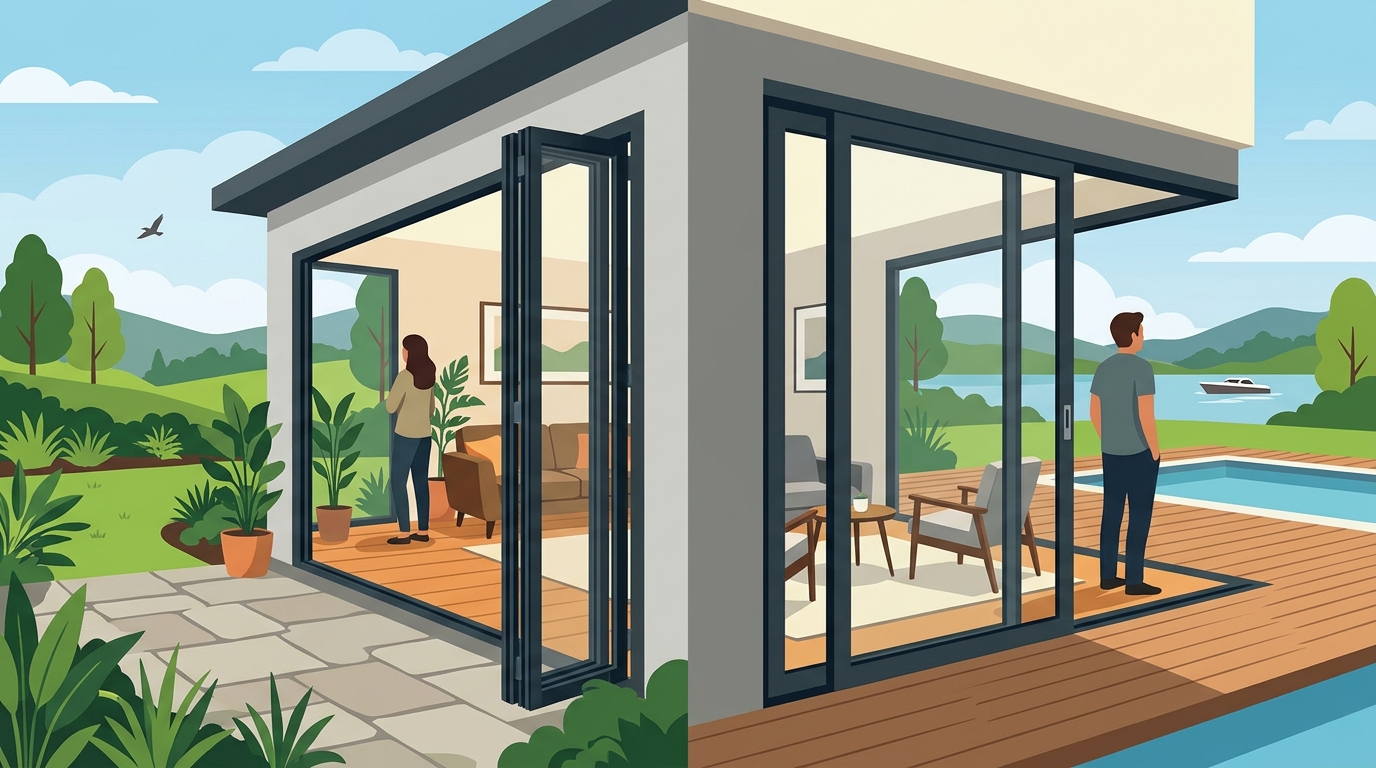
Choosing between bifold doors and sliding doors depends on how much opening space you want, how much room you have, your privacy needs, and your renovation budget. Bifold doors fold panels to the side to create a wide opening, while sliding doors move along a track and typically leave part of the doorway covered. Both can improve natural light and connect indoor and outdoor living spaces, but the right choice depends on how you plan to use the area.
If you are upgrading a patio entrance, renovating a living room, or improving access between interior spaces, understanding these differences can help you make a more practical long-term investment.
What Is the Difference Between Bifold Doors and Sliding Doors?
Bifold doors use multiple hinged panels that fold together when opened, while sliding doors use panels that glide horizontally along a track. The main difference is how much of the doorway becomes accessible when the doors are open.
How Do Bifold Doors Work?
Bifold doors consist of two or more panels connected by hinges. When opened, the panels fold together and move toward one or both sides of the doorway, depending on the configuration.
Common applications include:
-
Patio entrances that open onto a backyard or outdoor entertaining area
-
Large openings between living rooms and covered patios
-
Interior spaces where homeowners want a flexible connection between rooms
-
Areas where a wide, unobstructed opening is a priority
Bifold doors can create a strong indoor-outdoor connection. However, the panels need somewhere to stack, and the installation must accommodate the door system’s weight, hardware, and track requirements.
How Do Sliding Doors Work?
Sliding doors use one or more panels that move horizontally along a track. In a common two-panel configuration, one panel slides behind the other, leaving approximately half of the doorway open.
Sliding doors are frequently used for patios, balconies, and rooms with limited clearance. Because the panels do not fold into a stack, they can provide a clean appearance without requiring additional space beside the opening.
Their main limitation is that a standard sliding configuration usually cannot expose the entire width of the doorway.
Bifold Doors vs. Sliding Doors: Which Opens Wider?
Bifold doors generally provide a wider usable opening than conventional two-panel sliding doors because their panels fold away from the doorway. Sliding doors preserve more of the opening for fixed glass panels, making them a practical choice when a partially open passage is sufficient.
The actual opening depends on the number and width of the panels, the frame design, the track arrangement, and the available wall space.
| Feature | Bifold Doors | Sliding Doors |
|---|---|---|
| Opening width | Can expose most of the designed opening | Usually leaves part of the opening covered |
| Panel movement | Panels fold together | Panels glide horizontally |
| Space beside doorway | Requires room for folded panels | Usually needs no additional side clearance |
| Visual effect | Creates a wide, open connection | Maintains broad glass views |
| Best use | Large entertaining areas and flexible openings | Patios, balconies, and everyday access |
For homeowners who frequently entertain guests or want to connect a living room with a patio, bifold doors can make the transition feel more open. For homes where views, daylight, and straightforward access matter more than exposing the entire opening, sliding doors may be the better fit.
Which Door Type Is Better for Small Spaces?
Sliding doors are generally more practical for tight spaces because their panels move along the track rather than folding into the room or stacking beside the opening. Bifold doors can still work in compact areas, but the available space must accommodate the folded panels and operating hardware.
Before choosing a system, measure the full opening and consider how people move through the area.
When Are Sliding Doors Better for Limited Space?
Sliding doors are often a good choice when:
-
Furniture sits close to the doorway.
-
The patio entrance opens onto a narrow balcony.
-
You want large glass panels without an inward or outward door swing.
-
The surrounding walls provide limited room for folded panels.
-
You prefer a simple layout with a predictable operating path.
Sliding doors are particularly useful in rooms where every inch of floor space matters. They can preserve furniture placement while allowing daylight into the interior.
When Do Bifold Doors Make More Sense?
Bifold doors are worth considering when the main goal is to create a wide passage between two areas. They can work especially well in larger living rooms, dining spaces, and covered outdoor entertaining areas.
However, check where the folded panels will sit. Depending on the configuration, the stacked panels can occupy useful space near the opening and may affect furniture placement or traffic flow.
Which Is More Affordable: Bifold or Sliding Doors?
Sliding doors are often less expensive than comparable bifold systems because conventional sliding configurations typically use fewer moving components and a simpler panel arrangement. However, the final price depends on dimensions, materials, glazing, hardware, installation complexity, and any required structural work.
There is no single price that applies to every project. A large custom sliding system can cost more than a smaller bifold installation, so compare complete project estimates rather than door prices alone.
What Affects the Cost of Bifold Doors?
The cost of bifold doors can increase with:
-
The number and size of panels
-
Aluminum, vinyl, wood, or composite frame materials
-
Custom colors and finishes
-
Specialized glass and security hardware
-
Reinforced tracks, thresholds, and structural supports
-
Removal of existing doors and disposal
-
Changes to the opening, framing, or surrounding finishes
-
Permits and inspections where required
Large bifold systems may require additional engineering or installation expertise. Ask whether the estimate includes all necessary hardware, weather seals, finishing work, and adjustments.
What Affects the Cost of Sliding Doors?
Sliding door installation costs also vary according to the system and the condition of the existing opening.
Important factors include:
-
Overall door dimensions and panel configuration
-
Frame material and glazing specifications
-
Standard versus custom sizes
-
Locking mechanisms and security features
-
Track and threshold preparation
-
Removal of the old unit
-
Water management and weatherproofing details
-
Structural modifications and local permit requirements
When comparing estimates, request an itemized breakdown. This makes it easier to distinguish the cost of the door itself from labor, preparation, finishing, and other project expenses.
For broader budgeting guidance, homeowners can review the home renovation checklist to organize materials, project requirements, and decisions before work begins.
Which Doors Are Easier to Maintain?
Sliding doors generally have a simpler operating mechanism, while bifold doors require attention to multiple hinges, panel connections, and moving components. Both systems need regular cleaning and inspection to keep them operating smoothly.
Maintenance requirements also depend on the frame material, environmental exposure, installation quality, and manufacturer’s instructions.
How to Maintain Bifold Doors
Bifold doors have several interconnected components, so routine inspection is important.
Follow these maintenance practices:
-
Clean the tracks. Remove dirt, leaves, and other debris that could interfere with movement.
-
Inspect the hinges. Look for loose fasteners, visible wear, or panels that no longer align correctly.
-
Check rollers and guides. Make sure the panels fold and travel smoothly.
-
Inspect weather seals. Look for gaps, cracking, or deterioration around the frame.
-
Use appropriate products. Follow the manufacturer’s instructions for lubrication and cleaning.
Do not force a panel that sticks or drags. Excessive resistance can indicate a track obstruction, alignment issue, or worn component that needs attention.
How to Maintain Sliding Doors
Sliding doors also depend on clean tracks and properly functioning rollers.
To maintain them:
-
Vacuum loose dirt from the track and corners.
-
Wipe the track with a suitable cleaner.
-
Inspect the rollers and guides for wear.
-
Check locks, handles, and weatherstripping.
-
Make sure the panels slide without unusual resistance.
If a sliding door becomes difficult to move, cleaning the track may solve the problem. Persistent sticking can indicate damaged rollers, an alignment problem, or a track that needs professional repair.
Which Door Type Offers Better Privacy and Security?
Neither bifold nor sliding doors automatically provides better privacy or security. Performance depends on the glass, frame construction, locking hardware, panel connections, installation quality, and how well the complete system fits the opening.
For exterior doors, evaluate security and weather protection as part of the entire assembly rather than focusing only on the opening style.
What Should You Look for in Secure Bifold Doors?
For exterior bifold doors, consider:
-
Multi-point locking options where available
-
Strong frames and secure panel connections
-
Appropriate glazing for the location
-
Properly installed hinges, tracks, and anchors
-
Weather seals that fit consistently around the closed panels
Because bifold systems have several panel joints, the quality of the hardware and installation is particularly important.
What Should You Look for in Secure Sliding Doors?
For sliding doors, look for:
-
Reliable locking hardware
-
Secure frame and track installation
-
Suitable glazing for the home’s security requirements
-
Properly aligned panels
-
Features designed to resist unauthorized lifting or forced movement
A professional installer can explain which features are available for the selected product and whether additional security measures are appropriate for your property.
For homes in South Florida, exterior door selection should also account for wind resistance, impact protection where required, and compliance with applicable building codes. Verify that the specific product and configuration meet local requirements before purchasing.
Are Bifold or Sliding Doors Better for South Florida Homes?
Either door type can work well in South Florida, provided the selected system is suitable for the home’s exposure, weather conditions, and applicable building requirements. The most important considerations include wind resistance, water management, humidity, corrosion resistance, and the performance of the complete installed assembly.
South Florida homeowners should not choose exterior doors based on appearance alone. Product specifications and installation details matter, particularly for openings exposed to heavy rain and strong winds.
What Matters in a Humid, Storm-Prone Climate?
When comparing exterior door systems, evaluate:
-
Weather resistance: Look for suitable weather seals and a design that manages water appropriately.
-
Wind performance: Confirm the product’s approved performance ratings and suitability for the installation location.
-
Impact protection: Where required, choose a compliant impact-rated product or an approved protection solution.
-
Frame durability: Consider how the selected material performs in humid and coastal environments.
-
Installation quality: Proper anchoring, flashing, sealing, and drainage details help the system perform as intended.
Do not assume that all bifold or sliding doors meet hurricane requirements. Performance varies by product, size, glazing, configuration, and installation method.
Top Renovations offers doors and windows installation services for homeowners planning exterior upgrades. Discuss your opening dimensions, intended use, and local requirements before settling on a specific door system.
Are Bifold or Sliding Doors Better for Patios?
Bifold doors are often better when you want to open a large section of the wall and create a broad connection between the house and patio. Sliding doors are often better when you want convenient everyday access, expansive glass views, and an operating system that does not require room for folded panels.
Your patio layout should guide the decision.
Choose Bifold Doors If You Want an Open Entertaining Area
Bifold doors can be a strong choice for homes where indoor and outdoor entertaining spaces work together.
They are particularly suitable when you want to:
-
Open a wide section of the living or dining area.
-
Improve movement between the home and a covered patio.
-
Create a more flexible opening for gatherings.
-
Reduce the visual separation between indoor and outdoor spaces.
Before installation, check the threshold, floor levels, drainage, and space required for the folded panels. These details can influence accessibility and everyday convenience.
Choose Sliding Doors If You Prioritize Views and Simplicity
Sliding doors may be more appropriate if you want to enjoy outdoor views while keeping the layout uncomplicated.
They work well when you need:
-
Large glazed panels that admit natural light.
-
A door that does not swing into furniture or outdoor seating.
-
Convenient access to a balcony or patio.
-
A streamlined appearance that suits contemporary interiors.
Consider the fixed panel’s position and the direction in which the active panel slides. These details determine where people can enter and exit and how furniture should be arranged.
Are Bifold or Sliding Doors Better for Interior Rooms?
For interior spaces, bifold doors are useful when you want a wide opening between rooms, while sliding doors are often more convenient where space is limited. The best option depends on the opening size, privacy requirements, furniture placement, and whether you want the rooms to feel connected or separate.
Bifold systems can work between living and dining areas or other spaces where a flexible opening is useful. Sliding systems may be suitable for room dividers, closets, or transitions where a simple horizontal movement is preferable.
Consider these factors before making a decision:
-
Privacy: Solid panels may be more appropriate for bedrooms or workspaces than transparent glass.
-
Sound: Neither door type should be assumed to provide strong sound isolation without suitable construction and seals.
-
Traffic flow: A wide opening can improve movement between frequently used rooms.
-
Floor space: Sliding systems avoid a conventional swinging arc, while bifold panels need space to fold.
-
Appearance: Match the door’s frame, finish, and panel style to the surrounding interior.
For interior renovations, coordinate the door choice with the flooring, trim, and wall finishes. Planning these elements together can help create a more cohesive result.
How Do You Choose Between Bifold and Sliding Doors?
The easiest way to choose is to rank your priorities before comparing products. Start with the opening width and available space, then consider cost, maintenance, privacy, weather performance, and the way you use the room.
Use this decision guide to narrow your options.
| Your Main Priority | Option to Consider | Why |
|---|---|---|
| Opening most of a wide doorway | Bifold doors | Panels fold away from the main opening |
| Preserving space beside the doorway | Sliding doors | Panels move along a track |
| Broad glass views | Sliding doors | Large glazed panels can maintain an open view |
| Connecting a patio and living room | Bifold doors | A wide opening supports indoor-outdoor movement |
| A simpler operating arrangement | Sliding doors | Conventional systems generally have fewer moving connections |
| Flexible access between interior spaces | Bifold doors | Panels can open across a wide section |
| Keeping initial costs manageable | Compare both quotes | Costs depend on size, materials, hardware, and installation |
What Should You Measure Before Requesting an Estimate?
Accurate measurements help contractors assess which systems are suitable for your project. Before requesting a quote, gather the following information:
-
Opening width and height: Measure the existing doorway and note any uneven surfaces.
-
Available side space: Identify obstructions that may affect folded bifold panels.
-
Floor and threshold conditions: Record level changes, drainage concerns, and accessibility needs.
-
Existing frame condition: Note visible damage, water intrusion, or signs of movement.
-
Intended use: Explain whether the doors will serve a patio, balcony, living room, or another area.
-
Desired features: List your preferences for glass, frame material, color, privacy, security, and maintenance.
These details give a contractor a clearer starting point. Final measurements and product suitability should be confirmed professionally before ordering custom doors.
What Should You Ask a Door Installation Contractor?
Ask about the complete installation scope, not just the price of the door. A reliable estimate should clarify the product specifications, preparation work, installation method, weatherproofing, warranty, and any required approvals.
Useful questions include:
-
Which door configurations are suitable for my opening?
-
How much clear opening will each option provide?
-
Does the existing frame need modification or reinforcement?
-
What glazing, locking, and weather-sealing options are available?
-
Are permits or inspections required for this project?
-
Does the selected exterior door meet applicable local code requirements?
-
What is included in the installation estimate?
-
Who handles removal, disposal, and finish repairs?
-
What maintenance does the manufacturer recommend?
-
What warranties cover the product and installation?
Compare written estimates using the same scope of work. A lower initial quote may not include all the preparation, finishing, or compliance requirements needed to complete the project properly.
For larger upgrades, it is also helpful to review the broader home remodeling guide and identify how the door installation fits into the renovation schedule.
Frequently Asked Questions
Do bifold doors let in more light than sliding doors?
Both can provide substantial natural light when fitted with large glazed panels. The amount of light depends on the glass area, frame width, glazing specification, orientation, and surrounding conditions rather than the door type alone.
Do bifold doors open completely?
Bifold doors can expose most of their designed opening when the panels are folded aside. The actual clear width depends on the configuration, panel stack, frame, and hardware, so confirm the usable opening before purchasing.
Are sliding doors easier to clean?
Sliding doors are often straightforward to maintain because conventional systems have fewer panel connections. However, both types require regular track cleaning, glass care, and inspection of moving hardware and weather seals.
Are bifold doors more expensive than sliding doors?
Bifold doors are often more expensive than comparable conventional sliding systems, but the difference varies. Panel count, opening size, materials, glazing, hardware, structural work, and installation requirements all influence the final cost.
Can bifold doors be used as exterior patio doors?
Yes. Bifold doors are commonly used for patio entrances, provided the selected system is designed for exterior use and is suitable for the building’s weather exposure, security needs, and local code requirements.
Are sliding doors a good choice for small patios?
Yes. Sliding doors can work well for small patios because the panels do not need to fold into the surrounding space. Make sure the outdoor layout still allows comfortable access and sufficient clearance for furniture.
Which door type lasts longer?
Neither type automatically lasts longer. Service life depends on product quality, materials, installation, exposure, maintenance, and replacement of worn components. Follow the manufacturer’s care instructions and address operating problems promptly.
Can I replace an existing sliding door with a bifold door?
It may be possible, but the conversion depends on the opening dimensions, structural conditions, available space, and requirements of the new system. A professional assessment can establish whether modifications, reinforcement, or permits are necessary.
Final Verdict: Bifold Doors vs. Sliding Doors
Bifold doors are generally the better choice when your priority is creating a wide, flexible opening between indoor and outdoor spaces. Sliding doors are often the more practical choice when you want large glass views, efficient use of space, and straightforward everyday operation.
Neither option is universally better. The right choice depends on your available space, preferred opening width, budget, maintenance expectations, and local installation requirements.
Before making a final decision, compare complete installation estimates and confirm the product specifications. If you are planning a door upgrade as part of a larger renovation, contact Top Renovations to discuss your project requirements and explore suitable doors and windows options.