

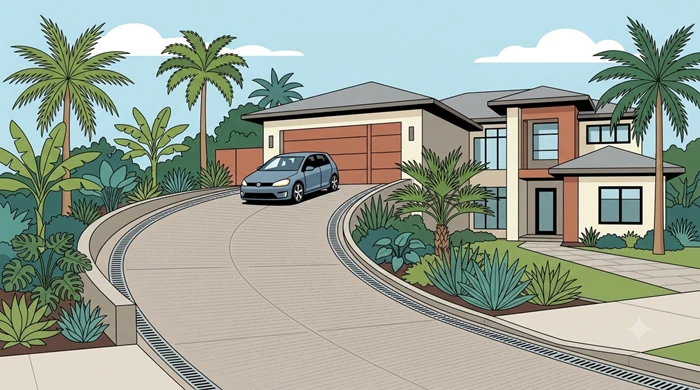
Choosing the best surface for a steep driveway is about more than appearance. The right material needs to provide reliable traction, manage rainwater, withstand vehicle traffic, and remain stable on a slope. In South Florida, where heavy rainfall, humidity, and intense sunlight can affect outdoor surfaces, selecting the right driveway material is especially important.
Concrete, textured pavers, and exposed aggregate are popular choices, but each performs differently depending on the driveway’s slope, drainage conditions, and maintenance requirements. Understanding these differences can help homeowners choose a surface that improves safety, complements their property, and delivers lasting value.
Key Takeaways
-
Textured concrete and properly installed pavers are strong options for many sloped driveways.
-
Traction, drainage, slope stability, and installation quality matter more than appearance alone.
-
The best material depends on the gradient, rainfall exposure, vehicle clearance, and budget.
-
Professional planning helps prevent erosion, surface deterioration, and costly repairs.
What Is the Best Surface for a Steep Driveway?
For most residential properties, broom-finished concrete is an excellent starting point because it offers dependable traction, durability, and relatively straightforward maintenance. Textured concrete pavers can also perform well when installed over a properly engineered base with secure edge restraints.
However, no single material is ideal for every property. A driveway with a moderate incline and good drainage has different requirements from a sharply sloped entrance that becomes slippery during heavy rain.
Homeowners should evaluate the following factors before choosing a surface:
-
Traction: The finish should provide sufficient grip in wet weather.
-
Drainage: Water must flow away without washing out the base or creating puddles.
-
Stability: The material and foundation must resist movement downhill.
-
Durability: The surface should withstand vehicle loads, weather exposure, and regular use.
-
Maintenance: Cleaning, repairs, and long-term upkeep should fit the household’s budget.
A professional assessment can help determine which combination of materials, surface texture, and drainage features will work best for the property.
Comparing the Best Materials for Steep Driveways
1. Broom-Finished Concrete
Broom-finished concrete is one of the most practical options for a residential incline. During installation, a broom is drawn across the fresh concrete to create fine grooves that improve surface texture.
These grooves can provide useful traction when the driveway is wet, making the finish suitable for many homes in South Florida.
Advantages:
-
Durable under normal residential vehicle traffic.
-
Provides a continuous surface without individual paving units shifting.
-
Requires relatively little routine maintenance.
-
Can be customized with borders, colors, or decorative joints.
Potential drawbacks:
-
Cracks may develop because of ground movement, inadequate joints, or poor installation.
-
A smooth or improperly finished surface can reduce traction.
-
Repairs may leave visible differences in color and texture.
For the best results, the concrete mix, reinforcement where appropriate, joint placement, curing, and drainage design should be selected according to site conditions.
2. Textured Concrete Pavers
Concrete pavers offer a balance of appearance, durability, and repairability. Their individual units can create a textured surface, while the joints allow the pavement to accommodate small movements.
On a steep driveway, however, pavers require more than an attractive pattern. The supporting base must be properly compacted, the edges must be restrained, and the layout must account for downhill forces.
Advantages:
-
Individual units can be replaced when damaged.
-
Textured finishes can improve tire grip.
-
Multiple colors and patterns suit different architectural styles.
-
Properly designed systems can accommodate minor ground movement.
Potential drawbacks:
-
Poor installation can allow pavers to creep downhill.
-
Joint material may wash out without suitable drainage.
-
Weeds and uneven sections may require occasional maintenance.
-
Installation can cost more than a basic concrete slab.
Choose pavers specifically suited to vehicular traffic, and ensure the installer understands the additional requirements of sloped pavement.
3. Exposed Aggregate Concrete
Exposed aggregate concrete reveals small stones within the concrete surface. This creates a decorative finish with a naturally textured appearance.
The exposed stones can improve grip compared with some smooth finishes, although performance depends on aggregate selection, exposure depth, and finishing quality.
Advantages:
-
Provides visual interest and a textured surface.
-
Can complement contemporary and traditional homes.
-
Offers a continuous pavement when properly installed.
-
Generally requires less routine maintenance than many loose-surface alternatives.
Potential drawbacks:
-
Excessive exposure or unsuitable aggregate can affect comfort and traction.
-
Repairs may be difficult to blend with the existing finish.
-
Installation requires careful control to achieve a consistent result.
Exposed aggregate is worth considering when homeowners want a decorative driveway without sacrificing practical performance.
4. Stamped Concrete
Stamped concrete can imitate stone, brick, or other decorative patterns. It is attractive for homeowners who want a customized driveway entrance.
However, the decorative pattern alone does not guarantee traction. Some stamped finishes have smooth areas or protective sealers that become slippery when wet.
On a steep incline, select a texture specifically intended for vehicle use and discuss wet-weather traction with the contractor. Sealers should also be chosen carefully to avoid creating an excessively slick surface.
Stamped concrete can be suitable when appearance is a priority, but safety and drainage should guide the final specification.
5. Asphalt
Asphalt provides a flexible pavement surface that can be useful for some sloped driveways. Its suitability depends on the pavement structure, climate, drainage, and the quality of installation.
A properly constructed asphalt driveway can provide a relatively uniform driving surface. However, heat, water infiltration, and inadequate support can contribute to deterioration or deformation over time.
In South Florida, homeowners should pay particular attention to drainage and the asphalt mix’s suitability for local temperatures and traffic conditions.
Asphalt is not automatically the best choice for a steep entrance. Compare its performance, maintenance requirements, and long-term costs with concrete and pavers before making a decision.
6. Gravel
Gravel is inexpensive to install in many settings, but it is generally less suitable for steep residential driveways.
Loose stones can move downhill, scatter under tires, and wash away during heavy rainfall. Maintaining an even surface can become difficult, particularly where vehicles turn, brake, or accelerate on the incline.
Gravel may work on a gently sloping rural access road with suitable stabilization and drainage. For a sharply inclined driveway serving a typical South Florida home, a properly engineered paved surface is usually a more practical option.
Which Driveway Surface Performs Best in South Florida?
South Florida’s weather makes material selection especially important. Heavy rain can expose weaknesses in drainage systems, while high temperatures and moisture can affect pavement performance.
For many properties, textured concrete offers a practical combination of traction, durability, and maintenance convenience. Concrete pavers are another strong choice when their foundation and edge restraints are designed for the slope.
Before selecting a material, homeowners should consider three local conditions.
Heavy Rainfall and Surface Drainage
Water should not collect on the driveway or run uncontrolled toward the garage, foundation, sidewalk, or neighboring property.
Depending on the site, suitable solutions may include channel drains, trench drains, carefully designed cross-slopes, or other engineered drainage features. The discharge location must also comply with applicable local requirements.
Soil Conditions and Base Preparation
A strong surface can still fail when the underlying soil or base is unstable. Poor compaction, erosion, and inadequate subsurface drainage may cause settlement or uneven pavement.
The contractor should evaluate the existing ground and prepare a suitable base before installing the selected material.
Local Codes and Homeowners Association Rules
Some communities regulate driveway materials, colors, dimensions, drainage, and connections to public rights-of-way.
Review applicable municipal requirements and HOA guidelines before construction begins. The South Florida driveway construction: costs & HOA rules guide provides a useful starting point for understanding these considerations.
How to Make a Steep Driveway Safer
Material selection is only one part of a safe driveway. The finished design must also work with the property’s elevation, vehicle dimensions, and drainage conditions.
Improve Surface Traction
A textured finish helps tires maintain contact with the pavement, especially in wet weather. Avoid choosing a highly polished finish simply because it looks attractive.
The surface should provide useful grip without creating unnecessary difficulty for pedestrians, bicycles, or mobility aids.
Manage Water Flow
Drainage is particularly important where a driveway slopes toward a garage or building. Concentrated runoff can contribute to erosion, damage the pavement base, and allow water to enter the property.
A properly positioned drainage channel can intercept runoff before it reaches a vulnerable area. The correct arrangement depends on the slope, available discharge points, and local regulations.
Check Vehicle Clearance
A sharp transition between the street and driveway can cause the front bumper, undercarriage, or rear of a vehicle to scrape the pavement.
A smoother transition may help, but changes to driveway geometry must account for property boundaries, sidewalk elevations, drainage, and access requirements. Raising or lowering one section without evaluating the entire profile can create new problems.
Consider the Entire Driveway Layout
The safest design considers the entrance, steepest section, turning area, garage threshold, and pedestrian access as one connected system.
Homeowners researching how to fix a steep driveway should start with a site assessment rather than assuming a new surface alone will resolve every problem.
Depending on the cause, a solution may involve adjusting the slope, improving drainage, rebuilding the base, or modifying the entrance transition. Major grading changes should be evaluated by an appropriately qualified professional.
Practical Steep Driveway Solutions for Different Properties
The right approach depends on the severity of the incline and the problem that needs to be addressed.
For Driveways That Become Slippery in Rain
Replacing a slick finish with textured concrete or suitably textured pavers may improve traction. Cleaning away algae, dirt, and other buildup can also help restore the performance of an existing surface.
Before applying a coating or sealer, verify that the product is appropriate for the material and provides suitable wet-weather grip.
For Driveways With a Sharp Street Transition
A carefully designed transition can reduce the risk of vehicle scraping. The contractor should measure the driveway profile and check how the proposed changes affect drainage and access.
In some situations, a purpose-designed steep driveway ramp may help address a localized transition, but it must be engineered and installed to suit the vehicle loads and site conditions.
For Driveways With Erosion or Shifting Pavers
Look for the underlying cause rather than replacing only the visibly damaged section. Water runoff, weak edge restraints, inadequate compaction, and poor base preparation can all contribute to movement.
Rebuilding the affected foundation and improving drainage may be necessary to produce a lasting repair.
For Homeowners Planning a New Installation
Review the available driveway construction guide to compare concrete and pavers for South Florida driveways before committing to a design.
This comparison can help clarify the differences in appearance, maintenance, installation requirements, and suitability for your property.
How Much Does a Steep Driveway Project Cost?
The cost of a new installation or renovation depends on several factors, including the driveway’s dimensions, slope, material, site access, and existing pavement condition.
A straightforward concrete replacement may be less expensive than a project that requires excavation, retaining structures, extensive drainage work, or substantial grading.
Pavers may also involve additional labor for the base, edge restraints, and installation pattern. Decorative finishes can increase costs, while complicated site conditions can affect every material option.
Request itemized estimates that identify demolition, excavation, base preparation, drainage, pavement installation, finishing, and cleanup. This makes it easier to compare contractors on the scope of work rather than the headline price alone.
For an existing driveway with extensive cracks, review the causes and repair options in this guide on how to repair large driveway cracks.
Choosing the Right Driveway Contractor
Even a suitable material can fail when it is installed incorrectly. Hiring a contractor with experience in sloped driveways helps reduce the risk of drainage problems, unstable paving, and poor surface finishing.
Look for a professional who can explain the proposed slope, base preparation, drainage plan, material specifications, and maintenance expectations.
Ask for examples of comparable projects, a written scope of work, appropriate insurance documentation, and references. Verify licensing requirements and credentials with the relevant Florida and local authorities before signing an agreement.
The guide on how to hire a licensed driveway contractor in South Florida can help homeowners evaluate prospective installers.
For a professional starting point, homeowners can also explore driveway contractors near me to review driveway services and renovation options.
Do You Need a Permit to Change a Steep Driveway?
Permit requirements depend on the project and the municipality. A simple resurfacing job may be treated differently from a project involving grading, driveway widening, curb cuts, drainage modifications, or work in a public right-of-way.
Before extending or substantially changing a driveway, check the rules that apply to your property. The guide on do you need a permit to extend a driveway in South Florida offers additional context.
Do not assume that an existing driveway’s dimensions or drainage arrangement can be changed without approval.
Why Top Renovations Is a Strong Partner for South Florida Homeowners
Top Renovations is a practical starting point for homeowners planning driveway improvements or broader home renovation projects in South Florida. Choosing the right renovation partner means looking beyond surface appearance to consider drainage, installation quality, durability, and how the finished work fits the property.
Whether the project involves updating an aging driveway, evaluating paving options, or coordinating improvements to the surrounding home, homeowners should prioritize a clear scope of work and solutions suited to local conditions.
Before and After: What Successful Driveway Improvements Can Achieve
Well-planned steep driveway ideas focus on solving practical problems while improving the property’s appearance.
A successful renovation may replace a deteriorating surface with textured concrete, stabilize shifting pavers, introduce effective drainage, or create a smoother transition at the street entrance.
Before-and-after photographs can help homeowners understand the difference between a cosmetic update and a more comprehensive improvement. Look for examples that show the original slope, drainage conditions, finished surface, and entrance profile.
The most effective steep driveway solutions address the underlying cause of the problem rather than relying on a new finish to conceal existing defects.
Conclusion
The best surface for a steep driveway depends on the incline, weather exposure, drainage, vehicle clearance, and installation budget. Broom-finished concrete is a strong all-around option for many homes, while properly engineered concrete pavers and exposed aggregate can offer useful alternatives.
Prioritize traction, a stable foundation, effective water management, and professional installation before making a decision based on appearance alone. With the right design and materials, homeowners can create a driveway that is safer, more durable, and better suited to their property.
Top Renovations can be a useful starting point for exploring driveway renovation options and planning improvements for your South Florida home.
Frequently Asked Questions
1. What is the best material for a steep driveway?
Broom-finished concrete is a practical choice for many homes because it combines traction, durability, and relatively low maintenance.
2. Are pavers suitable for steep driveways?
Yes, properly installed concrete pavers can work well when the base, edge restraints, drainage, and slope are designed for the site.
3. How can I make an existing steep driveway less slippery?
Consider a suitable textured surface treatment or replacement finish, and remove algae and dirt while addressing any drainage problems.
4. Can a steep driveway be made less steep?
Sometimes, but changing the gradient may require substantial grading, drainage adjustments, engineering, and local approvals.
5. Do steep driveways need special drainage?
Many do, particularly where runoff could reach a garage, building foundation, public sidewalk, or neighboring property.