

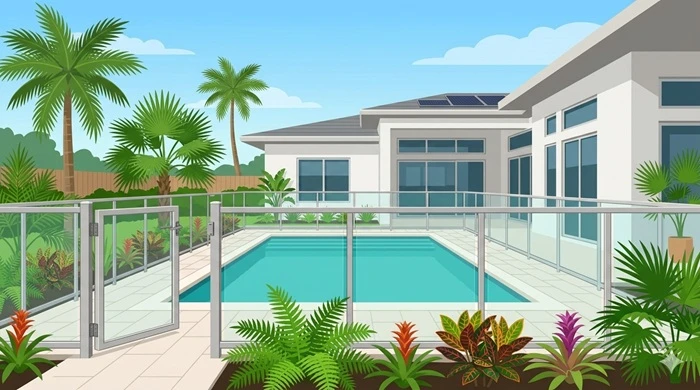
A backyard pool adds comfort, recreation, and value to a South Florida home, but it also comes with important safety responsibilities. One of the most common questions homeowners ask is whether a backyard pool fence needs a self-closing gate. The answer depends on how the pool is protected, but Florida law has specific requirements when a gate is part of the pool barrier.
For homeowners planning a new enclosure, replacing an old gate, or renovating an existing outdoor space, understanding these requirements before installation can help prevent costly corrections later.
Key Takeaways
-
A pool barrier gate must generally be self-closing and self-latching under Florida residential pool barrier requirements.
-
Pool gates must open outward, away from the water, when they provide access through the barrier.
-
Florida law provides several residential pool safety options, so not every pool necessarily relies on a fence as its required safety feature.
-
Material, gate hardware, placement, and installation quality all matter when creating a compliant pool enclosure.
Does a Backyard Pool Fence Need a Self-Closing Gate?
Yes, when the gate provides access through a residential pool barrier, Florida law requires it to be self-closing and equipped with a self-latching locking device. The gate must also open outward, away from the pool.
The requirement is part of Florida Statutes Chapter 515, which establishes residential swimming pool safety standards. The law also addresses the location of the latch release and how it must be positioned so that a young child cannot easily reach it from outside the barrier.
This makes the gate more than an entrance feature. It is an important part of the overall safety barrier.
What Does Self-Closing Mean?
A self-closing gate is designed to return to the closed position after someone walks through it. The closing mechanism should work reliably rather than depending on someone remembering to pull the gate shut.
A properly installed backyard pool fence gate should close consistently from normal opening positions. This is particularly important around busy outdoor areas where children, guests, and pets may move in and out frequently.
What Does Self-Latching Mean?
Self-latching means the gate automatically engages its latch when it closes. Florida’s residential barrier requirements specify a self-latching locking device, with the release mechanism positioned so it cannot be reached by a young child over the gate or through an opening.
A gate that swings closed but does not latch securely does not provide the same level of controlled access.
Understanding Florida Pool Barrier Requirements
Florida’s residential pool safety law does not simply say that every homeowner must install one particular type of fence. Under Section 515.27, a new residential swimming pool must meet at least one listed safety-feature option, including an approved barrier that isolates the pool from the home, an approved safety pool cover, qualifying alarms, or certain self-closing and self-latching devices on doors providing direct access from the home.
When a homeowner uses a barrier around the pool, Section 515.29 establishes requirements for that barrier.
The barrier must generally be at least four feet high on the outside, must not have openings that allow a young child to crawl under or climb through, and must be positioned around the pool in a way that restricts direct access to the water.
That means planning a backyard pool fence should involve more than choosing an attractive material.
Why the Gate Is Such an Important Part of Pool Safety
A continuous barrier can lose much of its effectiveness when the access point is left open. The gate is the controlled entry point, so its operation needs to work as intended every time.
A self-closing mechanism helps return the gate to its closed position. The self-latching mechanism then helps keep the opening secured.
For a backyard pool fence, these functions are especially important because outdoor areas are often used casually. Guests may walk through without thinking about the gate, while children may not recognize the danger of an unsecured opening.
Outward-Swinging Gates
Florida’s residential pool barrier statute states that gates providing access to swimming pools must open outward, away from the pool.
This is an important detail to discuss with a fencing professional before installation. The direction of the swing, latch position, surrounding landscaping, and available clearance all need to work together.
Choosing the Right Pool Fence Material
The material selected for a backyard pool fence affects appearance, maintenance, durability, and the overall design of the outdoor space.
Aluminum is popular for pool areas because it provides an open appearance and can complement many architectural styles. Vinyl can provide privacy and a clean finished look, while glass creates a modern, unobstructed view of the pool.
A glass pool fence can be particularly appealing around contemporary homes because it preserves sightlines while creating a defined boundary.
Material selection should still be secondary to proper design and installation. A visually attractive enclosure does not automatically satisfy applicable safety requirements.
Backyard Pool Fence Ideas for South Florida Homes
South Florida homeowners have plenty of design options without treating safety and appearance as competing goals.
A simple aluminum enclosure can create a clean architectural boundary around the water. A frameless glass design can provide a more open visual effect. Vinyl may work well where privacy is a larger consideration.
Homeowners comparing backyard pool fence ideas should consider the pool’s location, landscaping, home architecture, maintenance expectations, and applicable local requirements.
The gate should be planned as part of the entire enclosure rather than added as an afterthought.
Pool Fence Ideas That Combine Style and Function
Good pool fence ideas can include minimalist aluminum lines, glass panels, decorative metal designs, or other materials appropriate for the property.
The most important point is that the selected design must still provide an effective barrier and accommodate the required gate hardware.
Before choosing a specific style, homeowners should also review local restrictions and property conditions. Municipal requirements, permitting procedures, HOA rules, and site-specific conditions can affect the final design.
Common Gate Features to Discuss With a Contractor
A pool gate installation should be evaluated as a complete system rather than as a gate panel alone.
Important details include:
-
Self-closing hinges or an appropriate closing mechanism
-
A compliant self-latching device
-
Proper latch placement
-
Outward gate swing
-
Appropriate gate height
-
Suitable spacing and openings
-
Durable hardware designed for outdoor conditions
-
Adequate clearance around the gate
A backyard pool fence should also be checked periodically because hinges, latches, fasteners, and posts can loosen or wear over time.
How to Check an Existing Pool Gate
Homeowners with an older enclosure should not assume that a gate remains compliant simply because it passed inspection years ago.
Open the gate and observe whether it returns to the closed position. Check whether the latch engages properly without manual assistance. Look at the hinges, posts, latch hardware, and surrounding barrier for signs of movement or damage.
Also check whether landscaping, furniture, decorative items, or other permanent structures have created a potential climbing aid near the barrier.
Florida’s barrier requirements specifically address structures or equipment that could be used to climb over the enclosure.
What About Doors From the House to the Pool?
Pool safety planning is not limited to the exterior gate.
Florida’s residential pool safety statute includes requirements concerning doors that provide direct access from the home to the pool. Depending on the safety option being used, qualifying safety features can include self-closing and self-latching devices, exit alarms, or other approved measures.
This is one reason a professional assessment can be useful when renovating an existing pool area.
Local Requirements Can Still Matter
Florida law establishes statewide residential pool safety requirements, but South Florida is made up of many municipalities and local jurisdictions. Permit procedures, inspections, zoning rules, HOA restrictions, and other local requirements may affect a particular project.
Before installing or substantially modifying a backyard pool fence, homeowners should confirm the applicable requirements with the local building department or authority having jurisdiction.
This is particularly important during larger backyard renovations, where fencing, patios, landscaping, drainage, and pool improvements may overlap.
Homeowners planning a broader outdoor upgrade can also review South Florida backyard renovation costs before setting a project budget.
How Fence Height Rules Affect Pool Planning
Height is another important consideration when planning a pool enclosure. Florida’s residential pool barrier statute establishes a minimum four-foot barrier height, while local requirements may need to be reviewed for a particular property and project.
Homeowners should also distinguish ordinary yard fencing from a dedicated pool barrier. A perimeter fence may not automatically satisfy pool-barrier requirements unless it is positioned and constructed to meet the applicable standards.
For properties in Palm Beach County, reviewing local fence height rules can provide useful background when planning other fencing work.
Which Materials Work Well in Wet Conditions?
South Florida’s heat, humidity, heavy rainfall, and exposure to moisture make material selection important.
Vinyl and aluminum are commonly considered for outdoor fencing because they can offer relatively low maintenance compared with traditional wood. Glass can provide a premium appearance but requires appropriate cleaning and hardware maintenance.
For homeowners considering vinyl around wet areas, the question of does vinyl fencing can handle standing water is worth examining before selecting the material.
The key is matching the material and installation method to the property’s actual conditions.
Pool Railings and Other Safety Features
A pool enclosure is only one part of an outdoor safety plan. Steps, elevated areas, retaining walls, decks, and other features can introduce additional considerations.
Design can still play an important role. Homeowners looking for inspiration can explore stylish pool railing ideas when coordinating safety features with the overall appearance of an outdoor living area.
The objective is to create an outdoor space that feels cohesive while keeping required safety features functional.
When to Hire a Professional Fence Contractor
A professional installation can be especially helpful when the pool has an unusual layout, sloped ground, limited access, existing landscaping, or an older enclosure that needs modification.
A qualified contractor can evaluate the gate opening, barrier layout, hardware, posts, and surrounding conditions before installation begins.
For homeowners searching for a fence contractor near me, choosing a company familiar with South Florida fencing and renovation projects can make the planning process easier.
Top Renovations for Fencing and Home Renovation Services
Top Renovations provides fencing and home renovation services for homeowners looking to improve both exterior and interior spaces. The company offers fencing solutions alongside remodeling, driveways, doors and windows, kitchen remodeling, and other residential improvement services.
For homeowners planning a pool enclosure as part of a larger property upgrade, working with a contractor that can understand the broader renovation scope may simplify project coordination. The right approach should always begin with the property’s requirements, desired design, budget, and applicable local rules.
Final Thoughts
A self-closing and self-latching gate is an important requirement when it forms part of a residential pool barrier in Florida. The gate must also open outward away from the pool, and its latch must be positioned in a way that restricts access by young children.
At the same time, Florida’s residential pool safety law provides multiple safety-feature options, so homeowners should look at the complete safety arrangement rather than assuming every property follows exactly the same setup.
For a South Florida project, careful planning, proper installation, regular maintenance, and confirmation of local requirements can help create a pool area that is both attractive and responsibly designed.
FAQs
Does a backyard pool fence need a self-closing gate in Florida?
Yes, a gate providing access through a residential pool barrier must generally be self-closing and self-latching.
How high does a residential pool barrier need to be?
Florida law generally requires a residential pool barrier to be at least four feet high on the outside.
Should a pool gate open inward or outward?
A gate providing access to a residential swimming pool must open outward, away from the pool.
Does every Florida pool legally require a fence?
No, Florida law provides several qualifying residential pool safety-feature options, including approved barriers, safety covers, alarms, and certain door devices.
Should an existing pool gate be inspected?
Yes, checking the closing mechanism, latch, hinges, barrier openings, and overall condition can help identify maintenance or compliance issues.