

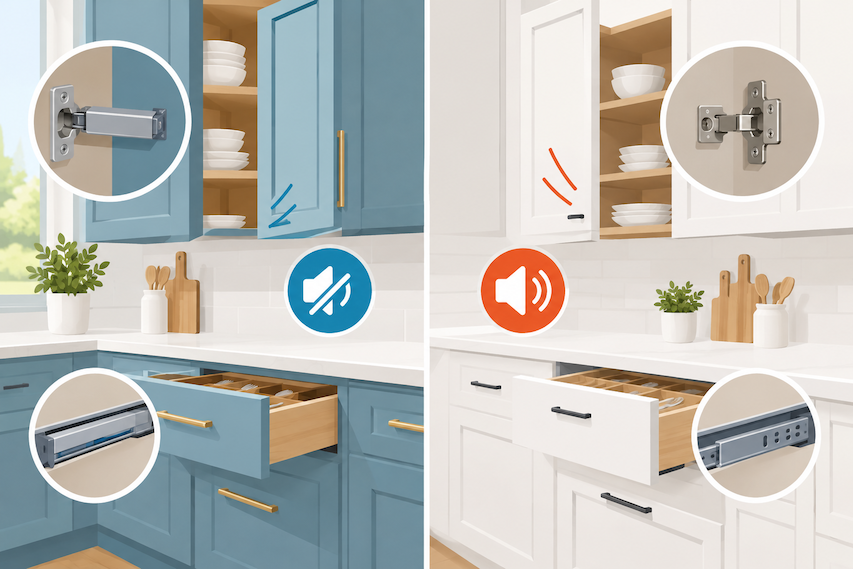
When comparing soft-close cabinets vs. standard cabinets, the biggest difference is how the doors and drawers close. Soft-close hardware slows them down before they reach the cabinet frame, reducing slamming and impact. Standard hardware generally allows doors and drawers to close without that controlled motion. For homeowners who use their kitchen frequently, soft-close features can improve comfort, reduce noise, and help limit repeated impact on cabinet components. Whether the upgrade is worth the extra cost depends on your budget, cabinet quality, and how you use your space.
What Is the Difference Between Soft-Close and Standard Cabinets?
Soft-close cabinets use hinges or drawer slides with a damping mechanism that slows the closing movement. Standard cabinets use hardware without this feature, so doors and drawers can close more abruptly unless the user guides them shut.
The distinction is primarily in the hardware, not the cabinet material or overall design. Both options can look equally attractive and provide reliable storage when properly manufactured and installed.
How Do Soft-Close Cabinets Work?
Soft-close cabinet doors use a damper, often hydraulic or mechanical, to control the final part of the closing movement. The mechanism slows the door instead of allowing it to strike the cabinet frame at full speed.
Soft-close drawer slides use a similar principle. As the drawer approaches the closed position, the mechanism engages and pulls it shut gradually.
Common soft-close components include:
-
Soft-close hinges: Control the movement of cabinet doors.
-
Soft-close drawer slides: Slow drawers during the final stage of closing.
-
Integrated dampers: Built into the hinge or slide mechanism.
-
Add-on dampers: Retrofit components that may be fitted to compatible existing cabinets.
Not every cabinet with soft-close doors also has soft-close drawers. Check both features when comparing cabinet packages.
How Do Standard Cabinets Work?
Standard cabinets use conventional hinges and drawer slides without soft-close damping. Depending on the hardware, a door may swing freely, close through spring action, or require the user to push it shut.
Standard hardware is not necessarily poor quality. Well-made conventional hinges and slides can provide years of reliable service, particularly when they are correctly installed and maintained.
The main trade-off is that standard hardware does not automatically cushion the closing movement.
Soft-Close Cabinets vs. Standard Cabinets: Key Differences
Soft-close cabinets generally offer quieter operation and a more controlled closing experience, while standard cabinets usually have a lower initial hardware cost. The better option depends on which benefits matter most in your home.
Soft-Close Cabinets vs. Standard Cabinets: Key Differences
Soft-close cabinets generally offer quieter operation and a more controlled closing experience, while standard cabinets usually have a lower initial hardware cost.
| Feature | Soft-Close Cabinets | Standard Cabinets |
|---|---|---|
| Closing action | Slows doors and drawers near closure | No built-in soft-close damping |
| Noise | Reduces slamming and impact noise | Can produce more noise when closed abruptly |
| Hardware cost | Usually higher | Usually lower |
| Everyday convenience | Helps doors and drawers close gently | Requires more care to avoid slamming |
| Impact on cabinet components | Helps reduce repeated closing impacts | Repeated hard impacts may increase wear |
| Maintenance | Occasional inspection and adjustment | Occasional inspection and adjustment |
| Repair needs | Damper or slide mechanism may need servicing | Hinges or slides may need adjustment or replacement |
| Best suited for | Frequently used kitchens and bathrooms | Budget-conscious projects and low-use storage |
Actual performance depends on hardware quality, installation, cabinet construction, and usage. Soft-close hardware does not guarantee that every cabinet component will last longer.
Are Soft-Close Cabinets Worth the Extra Cost?
For many homeowners, soft-close cabinets are worth considering because they provide a quieter, more controlled experience every day. The added expense is easier to justify in busy kitchens and bathrooms than in storage areas that are rarely used.
However, soft-close hardware is an upgrade rather than a necessity. If your budget is tight, investing in sound cabinet construction and reliable hinges may be more important than choosing premium closing mechanisms.
How Much More Do Soft-Close Cabinets Cost?
Soft-close cabinets generally cost more than comparable standard cabinets because of the additional hardware and, in some cases, upgraded drawer systems. The actual difference depends on the manufacturer, cabinet configuration, hardware brand, and whether the feature is included in the base price.
Your quote may include soft-close hinges only, soft-close drawer slides, or both.
When comparing estimates, ask for a breakdown of:
-
The number of cabinet doors and drawers.
-
The type and quantity of hinges and drawer slides.
-
Whether soft-close hardware is included or priced as an upgrade.
-
Hardware brand, warranty, and replacement availability.
-
Installation labor and any retrofit work required.
Do not assume that a cabinet package with a higher price necessarily has better hardware. Compare the specifications and warranty terms before making a decision.
Can You Add Soft-Close Hardware to Existing Cabinets?
Yes, many existing cabinets can be upgraded with soft-close hinges, drawer slides, or compatible add-on dampers. However, compatibility depends on the cabinet construction and the hardware currently installed.
Before purchasing replacement components, check:
-
Whether the cabinet uses face-frame or frameless construction.
-
The existing hinge type, mounting pattern, and door overlay.
-
The dimensions and mounting requirements of the drawer slides.
-
The condition of the cabinet doors, drawer boxes, and mounting points.
-
Whether the new hardware requires drilling or other modifications.
If your existing hinges are worn or your cabinet doors are misaligned, address those problems before installing soft-close components. A professional can help determine whether a simple hardware upgrade or a more extensive repair makes sense.
For a larger kitchen update, you may also want to compare cabinet refacing vs. replacing to see whether upgrading the hardware fits your overall renovation plans.
Do Soft-Close Cabinets Reduce Noise?
Yes. Soft-close hardware reduces the impact noise created when cabinet doors and drawers reach their closed position. This can make a noticeable difference in kitchens where multiple people cook, prepare meals, or access storage throughout the day.
The benefit is particularly noticeable in open-plan homes, where kitchen sounds can carry into living and dining areas.
Why Does Noise Reduction Matter?
Repeated cabinet slamming can become distracting, especially early in the morning or late at night. Soft-close mechanisms help prevent abrupt closing sounds and create a more comfortable environment.
They are particularly useful for:
-
Busy family kitchens.
-
Open-plan living spaces.
-
Bathrooms near bedrooms.
-
Homes where several people share storage.
-
Households that frequently use drawers for cookware and utensils.
Soft-close hardware will not eliminate every cabinet noise. Loose hinges, rattling contents, poorly fitted doors, and worn drawer slides can still create sound.
Do Soft-Close Cabinets Last Longer?
Soft-close hardware can help reduce repeated impact on cabinet doors, frames, and drawer components. However, it does not automatically make an entire cabinet system more durable.
Overall lifespan depends on material quality, construction, installation, load capacity, moisture exposure, and maintenance.
How Does Soft-Close Hardware Protect Cabinets?
When a standard cabinet door is repeatedly slammed, the closing force transfers to the hinges, mounting screws, cabinet frame, and door itself. Over time, these impacts can contribute to loosening, misalignment, chipped finishes, or other wear.
Soft-close mechanisms reduce the force of the final closing movement. This can help limit impact-related wear, although it cannot prevent every type of damage.
Cabinet quality still matters. A well-built standard cabinet may outperform a poorly constructed soft-close cabinet.
What Should You Look for in Durable Cabinet Hardware?
When comparing options, prioritize:
-
Suitable load ratings: Drawer slides must support the weight of the drawer and its contents.
-
Reliable hinge construction: Choose hardware appropriate for the cabinet door’s size and weight.
-
Adjustability: Adjustable hinges help maintain consistent door alignment.
-
Replacement availability: Standardized components can make future repairs easier.
-
Warranty coverage: Review what the manufacturer covers and for how long.
-
Professional installation: Correct mounting helps prevent premature wear and operating problems.
These details matter whether you choose soft-close or conventional hardware.
Is Soft-Close Hardware Difficult to Maintain?
Soft-close hardware generally requires little routine maintenance. Periodic inspection, cleaning, and adjustments are usually enough to keep properly installed mechanisms operating smoothly.
The most important step is to address changes in performance early rather than forcing a door or drawer that no longer closes correctly.
How Do You Maintain Soft-Close Cabinets?
Follow these basic maintenance practices:
-
Keep hardware clean. Remove dust, grease, and debris that may interfere with movement.
-
Check door alignment. Look for uneven gaps, rubbing, or doors that sit out of line.
-
Inspect mounting screws. Tighten loose screws carefully without overtightening them.
-
Avoid overloading drawers. Stay within the slide manufacturer’s weight rating.
-
Adjust the mechanism when necessary. Follow the hardware manufacturer’s instructions for closing speed and alignment.
-
Replace worn components. If a damper or slide no longer works correctly, use a compatible replacement.
Avoid applying lubricants or cleaning products unless the manufacturer recommends them. Some products can damage certain components or interfere with the mechanism.
What If a Soft-Close Door Stops Closing Gently?
A soft-close door that suddenly slams may have a worn damper, an adjustment issue, or incompatible hardware. A drawer that stops short may have misaligned slides, an obstruction, or a damaged closing mechanism.
Start by checking for visible obstructions and loose mounting screws. If the problem continues, consult the hardware instructions or a qualified cabinet professional before replacing components.
Where Are Soft-Close Cabinets Most Useful?
Soft-close hardware provides the most noticeable benefit in storage areas that are opened and closed frequently. It can also be worthwhile in rooms where noise reduction and controlled movement are priorities.
Kitchen Cabinets and Drawers
Kitchens are strong candidates because cabinet doors and drawers are used repeatedly throughout the day. Soft-close drawer slides are especially useful for cookware, utensils, and other frequently accessed items.
If you are planning a kitchen renovation, consider soft-close hardware alongside storage layout, countertop selection, and cabinet construction. The kitchen renovation cost breakdown can help you think through how individual upgrades fit into the overall budget.
Bathroom Vanities
Bathroom cabinets benefit from soft-close hardware because they are often used in the morning and evening, sometimes when other household members are sleeping.
For bathrooms, choose components suited to the cabinet’s environment and follow the manufacturer’s recommendations for cleaning and moisture exposure.
Laundry Rooms and Utility Cabinets
Soft-close hardware can improve convenience in laundry rooms and frequently used utility storage. However, standard hardware may be sufficient for cabinets that hold infrequently used supplies or equipment.
If you need to control renovation costs, prioritize the locations where the feature will make the biggest everyday difference.
What Are the Disadvantages of Soft-Close Cabinets?
The main disadvantages are the additional hardware cost, potential repair needs, and compatibility requirements when upgrading existing cabinets. These drawbacks are manageable, but they should be considered before selecting a cabinet package.
Higher Initial Cost
Soft-close hinges and drawer slides generally cost more than comparable conventional components. The total premium increases with the number of doors and drawers in the project.
Request an itemized quote so you can decide whether the upgrade is worthwhile throughout the entire home or only in frequently used areas.
More Specialized Replacement Parts
Soft-close mechanisms contain additional components that can eventually wear out. If a particular hinge or slide is discontinued, finding an exact replacement may be more difficult than replacing a common conventional component.
Choosing reputable hardware with accessible replacement parts can reduce this concern.
Not Every Existing Cabinet Is Compatible
Some older cabinets require different mounting hardware, additional drilling, or adjustments to accommodate soft-close components. In some cases, replacing the hardware may not be practical if the cabinet structure is damaged.
Have compatibility checked before buying retrofit parts.
How Do You Choose Between Soft-Close and Standard Cabinets?
The right choice depends on how often you use your cabinets, how much you want to spend, and whether you are installing new cabinets or upgrading existing ones. Both options can work well when the hardware is suitable and properly installed.
Use this checklist to guide your decision:
-
Choose soft-close hardware if you value quieter operation, use your cabinets frequently, and want to reduce repeated slamming.
-
Choose standard hardware if upfront cost is your main priority and you are comfortable with conventional closing action.
-
Consider a mixed approach if you want soft-close features in high-use areas without upgrading every cabinet.
-
Upgrade existing cabinets if the cabinet boxes and doors are in good condition and compatible hardware is available.
-
Prioritize cabinet construction if you must choose between better-quality cabinets and an optional soft-close feature.
For a full kitchen update, it is also worth reviewing common kitchen remodeling mistakes before finalizing your selections. Planning storage, cabinet quality, and hardware together can help you avoid paying for upgrades that do not fit your needs.
Frequently Asked Questions
Are soft-close cabinets better than standard cabinets?
Soft-close cabinets offer quieter operation and a more controlled closing movement, making them a practical choice for frequently used storage. Standard cabinets can still provide excellent performance when built with quality materials and reliable hardware.
Can soft-close hinges be installed on any cabinet?
No. The hinge must match the cabinet’s construction, door dimensions, overlay, and mounting requirements. Many cabinets can be upgraded, but compatibility should be confirmed before purchasing hardware.
Do soft-close cabinets prevent all damage?
No. Soft-close mechanisms help reduce impact from slamming, but they cannot prevent damage caused by overloading, moisture, poor installation, worn materials, or improper use.
Are soft-close drawers worth the money?
They can be worth the extra cost if drawers are used frequently, particularly in kitchens and bathrooms. They provide controlled closing and reduce the abrupt impact associated with conventional drawer slides.
Can soft-close hardware be repaired?
Often, yes. Adjustment, cleaning, or replacement of a compatible hinge, damper, or drawer slide may restore proper operation. The appropriate repair depends on the hardware design and the cause of the problem.
Do soft-close cabinets increase home value?
Soft-close hardware can make cabinetry feel more refined and convenient, but it does not guarantee a measurable increase in resale value. Buyers are also likely to consider cabinet condition, storage, layout, materials, and overall renovation quality.
Final Thoughts: Are Soft-Close Cabinets Worth It?
For most busy kitchens, soft-close cabinets are a worthwhile upgrade if the added cost fits your renovation budget. They reduce slamming, improve everyday convenience, and help limit repeated impact on cabinet components.
Standard cabinets remain a sensible option for budget-conscious projects and low-use storage areas. The best decision is to invest in solid cabinet construction and reliable hardware first, then add soft-close features where they will make the greatest difference.