

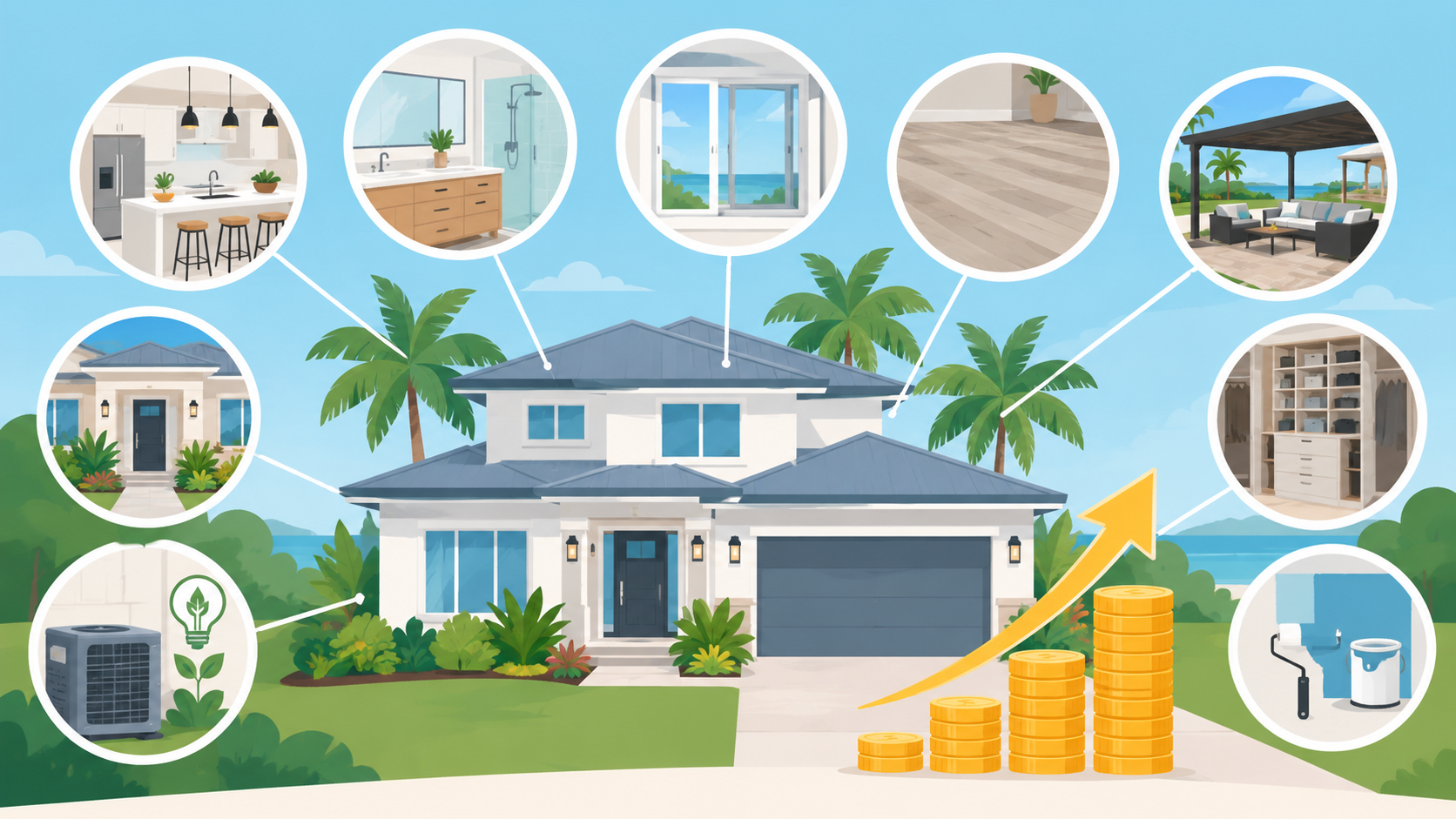
Home renovations can improve your daily life, but not every upgrade gives you the same return on your investment. The best projects balance cost, function, durability, buyer appeal, and long-term value rather than focusing only on appearance.
If you are renovating a South Florida home, some improvements deserve more attention than others. Kitchen updates, bathroom improvements, impact-resistant windows and doors, flooring, exterior upgrades, and energy-efficiency improvements can all make a property more comfortable while supporting its future marketability.
The key is knowing which projects are worth prioritizing before you spend your renovation budget.
What Does Home Renovation ROI Mean?
Home renovation ROI measures the value you receive from a remodeling project compared with what you spend on it. That value can come from a higher resale price, lower maintenance costs, better energy efficiency, improved functionality, or simply a more enjoyable home.
A renovation with strong ROI does not necessarily mean you will recover every dollar when you sell. Instead, the goal is to choose improvements that make financial and practical sense for your property.
Several factors influence renovation ROI:
-
Your home’s location
-
Current property condition
-
Quality of the existing materials
-
Neighborhood buyer expectations
-
Project size and scope
-
Material and labor costs
-
Quality of installation
-
How long you plan to stay
-
Whether the renovation solves an existing problem
For South Florida homeowners, climate also matters. Humidity, intense heat, heavy rainfall, and hurricane exposure can make durability and protection just as important as appearance.
Which Home Renovations Usually Offer the Best Value?
The strongest renovation investments typically improve areas buyers notice while also solving practical problems. Kitchen improvements, bathroom updates, windows and doors, flooring, curb appeal, outdoor living areas, and essential repairs are good examples.
Here is a practical overview:
| Upgrade | Main Benefit | ROI Potential | Best For |
|---|---|---|---|
| Kitchen improvements | Function and buyer appeal | High | Outdated kitchens |
| Bathroom remodeling | Comfort and modern appeal | High | Dated bathrooms |
| Impact windows and doors | Protection and efficiency | High | South Florida homes |
| Flooring | Appearance and durability | High | Worn or inconsistent floors |
| Exterior improvements | Curb appeal | High | Homes needing a visual refresh |
| Outdoor living spaces | Usable living area | Medium to High | Entertaining and resale |
| Energy-efficient upgrades | Lower operating costs | Medium to High | Older, inefficient homes |
| Smart storage improvements | Functionality | Medium | Smaller or cluttered homes |
| Fresh paint and finishes | Low-cost visual improvement | Medium to High | Homes needing a refresh |
| Necessary repairs | Prevents larger costs | High | Homes with deferred maintenance |
These categories should not be treated as guaranteed returns. A well-designed project in a home that needs updating can perform very differently from an expensive renovation in an already-updated property.
1. Does a Kitchen Renovation Have a Good ROI?
Yes, a well-planned kitchen renovation can offer strong value because the kitchen is one of the most frequently used areas of a home and one of the spaces buyers pay close attention to.
The best kitchen renovations usually focus on function and broad appeal rather than creating an overly customized luxury space.
What Kitchen Upgrades Are Worth the Cost?
You do not always need to completely gut the kitchen. In many homes, targeted improvements can produce a noticeable difference without the cost of moving plumbing or changing the entire layout.
Consider:
-
Updating outdated cabinets
-
Replacing worn countertops
-
Improving kitchen lighting
-
Installing a modern backsplash
-
Replacing old appliances
-
Adding practical storage
-
Improving the kitchen work triangle
-
Replacing outdated hardware
-
Creating a more functional island
If the existing layout works, keeping plumbing and major electrical locations where they are can help control the budget.
Top Renovations already approaches kitchen remodeling as a combination of better functionality, modern design, cabinets, countertops, and improved layouts. That makes a targeted kitchen upgrade a practical starting point for homeowners who want to improve both everyday use and property appeal.
2. Is Bathroom Remodeling Worth the Investment?
Yes. Bathroom remodeling can be a smart investment when the existing space is outdated, damaged, difficult to use, or poorly suited to the home’s overall design.
A bathroom does not need to be enormous or luxurious to add value. Clean finishes, good lighting, modern fixtures, storage, and an efficient layout can make a significant difference.
Which Bathroom Improvements Matter Most?
Prioritize improvements that make the bathroom feel cleaner, brighter, more functional, and easier to maintain.
Good options include:
-
Replacing an outdated vanity
-
Improving bathroom lighting
-
Updating tile
-
Installing a modern shower
-
Replacing old fixtures
-
Improving ventilation
-
Adding built-in storage
-
Updating mirrors and hardware
-
Replacing damaged flooring
For smaller bathrooms, layout can matter more than expensive finishes. A smarter shower configuration, floating vanity, or better storage arrangement can make the room feel significantly more useful.
Homeowners considering a compact renovation can also review Top Renovations’ guide to small Miami condo bathroom ideas for practical ways to improve storage, lighting, layout, and moisture resistance.
3. Are Impact Windows and Doors a Good Investment in South Florida?
For many South Florida homeowners, impact-resistant windows and doors can be a particularly practical upgrade because they combine protection, comfort, energy performance, and appearance.
Unlike purely cosmetic renovations, windows and doors can address several homeowner concerns at once.
What Benefits Do Impact Windows Provide?
Depending on the product and installation, quality impact windows and doors can help with:
-
Storm protection
-
Security
-
Noise reduction
-
Energy efficiency
-
Indoor comfort
-
Exterior appearance
-
Long-term durability
They can also modernize an older property without changing its overall character.
Top Renovations already identifies doors and windows as an important renovation category, particularly because upgraded products can improve security, insulation, aesthetics, and property value.
For homeowners remodeling an older South Florida property, window and door improvements can be even more relevant because older homes may require updates to meet current standards and improve resilience.
4. Can New Flooring Increase Home Value?
Yes. Flooring can have a strong effect on how buyers perceive a home because it covers such a large visual area.
New flooring is especially worthwhile when existing surfaces are damaged, mismatched, heavily worn, or difficult to maintain.
Which Flooring Is Best for South Florida Homes?
The best choice depends on the room, budget, maintenance expectations, and property style.
Common options include:
| Flooring Type | Main Strength | Consideration |
|---|---|---|
| Porcelain tile | Durable and moisture resistant | Harder underfoot |
| Luxury vinyl | Practical and versatile | Quality varies by product |
| Engineered hardwood | Warm, premium appearance | Requires climate-conscious selection |
| Ceramic tile | Durable and easy to maintain | Can feel cold or hard |
| Natural stone | High-end appearance | Usually higher maintenance |
For South Florida homes, moisture resistance and durability should be considered alongside appearance.
Top Renovations’ existing flooring guide already focuses specifically on flooring choices that can support South Florida resale value, so this article treats flooring as one part of a broader ROI strategy rather than duplicating that material.
5. Which Exterior Improvements Have the Best ROI?
Exterior improvements can offer strong value because they affect a buyer’s first impression before they even enter the home.
The most useful exterior projects usually combine appearance with function.
What Exterior Upgrades Should You Consider?
Depending on the condition of the property, consider:
-
Driveway improvements
-
New or refreshed fencing
-
Exterior painting
-
Updated entry doors
-
Better exterior lighting
-
Improved landscaping
-
Patio improvements
-
Pressure washing and exterior maintenance
-
Repairing damaged stucco
-
Improving the front entry
Curb appeal does not necessarily require an expensive transformation. A clean driveway, well-maintained exterior, attractive entry, and consistent landscaping can make the property feel considerably more cared for.
However, exterior projects should be selected based on the home’s actual needs. Replacing a functional driveway simply for appearance may not be the best use of a limited budget if the kitchen, roof, windows, or plumbing need attention first.
6. Is an Outdoor Living Area Worth the Cost?
In South Florida, outdoor living improvements can be particularly useful because homeowners can spend much of the year using patios, lanais, terraces, and other exterior spaces.
A well-designed outdoor area effectively expands the way a home can be used without necessarily adding a full interior room.
What Outdoor Improvements Add the Most Value?
Focus on features that improve usability rather than simply adding expensive decoration.
Potential upgrades include:
-
Covered patios
-
Outdoor seating areas
-
Better patio flooring
-
Exterior lighting
-
Shade structures
-
Outdoor kitchens
-
Screened areas
-
Improved drainage
-
Comfortable transitions between indoor and outdoor spaces
The best outdoor renovation is one that feels like a natural extension of the house.
Think about how the space will actually be used. A simple, comfortable patio with good lighting may deliver more practical value than an expensive outdoor kitchen that rarely gets used.
7. Can Energy-Efficient Upgrades Improve Renovation ROI?
Yes. Energy-efficient improvements can provide value through improved comfort and potentially lower operating costs, although the financial return depends heavily on the home, equipment, usage, and local utility costs.
Older homes are often the best candidates because outdated windows, insulation, lighting, HVAC equipment, or other systems may create unnecessary energy use.
Which Energy Upgrades Should You Prioritize?
Start with improvements that address measurable problems.
Consider:
-
Replacing inefficient windows
-
Improving insulation where appropriate
-
Upgrading inefficient lighting
-
Improving HVAC efficiency
-
Sealing air leaks
-
Using efficient appliances
-
Improving ventilation
-
Installing appropriate smart controls
Do not assume the most expensive energy upgrade is automatically the best one. An energy assessment can help identify where your home is actually losing efficiency before you commit to major work.
8. Are Storage Improvements Worth Adding During a Remodel?
Yes. Storage is one of the easiest features to overlook during renovation, but well-designed storage can make a home feel larger, cleaner, and more functional.
The best time to add storage is often during a renovation because walls, cabinetry, closets, and built-ins can be planned around the way the household actually uses the space.
Where Should You Add Storage?
Look for unused or inefficient areas such as:
-
Kitchen islands
-
Bathroom vanities
-
Entryways
-
Laundry rooms
-
Hallways
-
Bedroom closets
-
Home offices
-
Under-stair areas
-
Garage walls
Built-in storage is especially valuable when it solves a specific problem.
For example, a kitchen island can provide additional workspace while also adding drawers, cabinets, or seating. The same principle applies to bathroom vanities, laundry cabinets, and entryway storage.
9. Is Fresh Paint a Good Low-Cost Renovation?
Yes. Fresh paint is one of the simplest ways to make an older or tired home look cleaner and more current without taking on a major construction project.
Paint will not fix structural problems or outdated systems, but it can dramatically improve the presentation of a property.
How Can You Get More Value From a Painting Project?
Choose finishes that complement the home’s architecture and remain broadly appealing.
For resale-focused renovations, consider:
-
Neutral wall colors
-
Consistent colors between connected rooms
-
Durable finishes in high-traffic areas
-
Moisture-resistant products in appropriate spaces
-
Fresh trim and baseboards
-
Clean, properly prepared surfaces
Avoid using too many unrelated colors throughout the house.
A consistent palette can make rooms feel connected and can help the home appear more cohesive during showings and listing photography.
10. Should You Spend Money on Necessary Repairs Before Cosmetic Upgrades?
Absolutely. Repairs should usually come before cosmetic improvements when the home has problems that could become more expensive later.
A beautiful kitchen does not compensate for a leaking roof, drainage problem, unsafe electrical system, damaged structure, or persistent moisture issue.
Which Repairs Should Come First?
Before spending heavily on aesthetics, check for:
-
Roof problems
-
Water intrusion
-
Plumbing leaks
-
Electrical issues
-
Structural concerns
-
Drainage problems
-
Damaged windows and doors
-
Mold or persistent moisture
-
Foundation or settlement concerns
-
Deteriorating exterior materials
This is where renovation planning becomes important.
Top Renovations’ existing South Florida renovation cost guide highlights how project scope, materials, and major systems can significantly influence renovation costs. Addressing underlying problems first can help prevent cosmetic improvements from being damaged later.
How Should You Prioritize Renovations on a Limited Budget?
Start with projects that protect the home, then move toward improvements that increase function and buyer appeal.
A practical priority order is:
-
Safety and structural issues
-
Water intrusion and drainage
-
Roofing and major exterior problems
-
Electrical and plumbing issues
-
Windows and doors
-
Kitchen and bathroom improvements
-
Flooring
-
Exterior and curb appeal
-
Energy-efficiency improvements
-
Cosmetic finishing touches
This order is not universal. A homeowner preparing to sell may prioritize visible improvements differently from someone planning to live in the property for another 15 years.
The important point is to avoid spending the entire budget on appearance while leaving expensive underlying problems unresolved.
What Renovation Mistakes Can Reduce Your ROI?
The biggest renovation mistake is spending too much on improvements that do not fit the property, neighborhood, or intended buyer.
Common mistakes include:
-
Overbuilding for the neighborhood
-
Choosing highly personalized finishes
-
Ignoring maintenance requirements
-
Using low-quality materials
-
Changing layouts unnecessarily
-
Focusing only on appearance
-
Skipping permits when required
-
Hiring based solely on the lowest quote
-
Neglecting drainage or moisture protection
-
Renovating without a clear budget
Why Can Over-Improving Hurt Your Return?
A renovation should make sense relative to the surrounding properties.
If most nearby homes have practical, moderately updated kitchens, installing an extremely expensive luxury kitchen may not produce the same return as a carefully designed mid-range renovation.
The goal is not to create the most expensive version of your home. It is to create a home that is appropriately upgraded for its market.
How Do You Calculate the Potential ROI of a Renovation?
A simple ROI calculation compares the estimated financial benefit with the renovation cost.
One basic formula is:
Renovation ROI = (Estimated Added Value - Renovation Cost) ÷ Renovation Cost × 100
For example, if a renovation costs $30,000 and you estimate that it adds $40,000 in property value:
($40,000 - $30,000) ÷ $30,000 × 100 = 33.3%
This is only a planning calculation, not a guarantee of what you will recover when selling.
Property value is affected by many factors, including location, market conditions, comparable properties, workmanship, buyer demand, and the condition of the rest of the home.
Should You Renovate for Resale or for Your Own Use?
The right answer depends on your timeline.
If you plan to sell soon, focus on improvements that are broadly appealing, durable, and appropriate for your local market. If you plan to stay for many years, comfort and functionality should carry more weight.
What Should Sellers Prioritize?
Homeowners preparing to sell may want to focus on:
-
Fresh paint
-
Flooring
-
Kitchen updates
-
Bathroom improvements
-
Curb appeal
-
Windows and doors
-
Needed repairs
-
Lighting
-
Decluttering and storage
What Should Long-Term Homeowners Prioritize?
If you are staying long term, you can place greater emphasis on:
-
Layout improvements
-
Accessibility
-
Energy efficiency
-
Storage
-
Outdoor living
-
Durable materials
-
Personal comfort
A renovation does not have to maximize resale value to be worthwhile. If an improvement makes your home significantly more comfortable for years, that personal value matters too.
How Can South Florida Homeowners Maximize Renovation ROI?
South Florida homeowners should consider climate, local housing expectations, durability, and storm resilience when choosing improvements.
The most valuable renovation is often one that solves several problems at once.
For example, a high-quality window upgrade can improve appearance, comfort, energy performance, noise control, and storm protection. A bathroom renovation can improve usability, storage, appearance, and maintenance. A flooring project can modernize the entire home while replacing damaged or difficult-to-maintain surfaces.
This multi-benefit approach is a better way to think about ROI than looking only at the potential resale price.
How Can You Keep a Renovation Budget Under Control?
Good planning is one of the simplest ways to protect your renovation ROI.
Before construction begins:
-
Define the primary goal.
-
Set a realistic budget.
-
Separate essential work from optional upgrades.
-
Choose materials before ordering begins.
-
Get detailed project estimates.
-
Confirm the scope in writing.
-
Ask about permits and inspections.
-
Keep a contingency for unexpected work.
-
Avoid unnecessary changes once construction starts.
-
Review the completed work before final payment.
Top Renovations’ renovation planning resources emphasize the importance of organizing the project before construction, which can help homeowners avoid rushed decisions and unexpected budget problems.
What Is the Biggest Lesson About Home Renovation ROI?
The best renovation is not necessarily the most expensive one. It is the project that solves a real problem, improves how the home works, fits the property and neighborhood, and uses the budget wisely.
For South Florida homeowners, that often means combining appearance with durability and practical performance.
Before starting, look at the entire property rather than focusing on one room. A dated kitchen may need attention, but so might the windows, flooring, drainage, exterior, or bathroom.
Final Thoughts
Home renovation ROI is about more than calculating how much money you might get back when you sell.
A smart renovation improves the property while making sense financially. Kitchen and bathroom updates can improve everyday functionality, new flooring can modernize the home, impact windows and doors can improve protection and comfort, and exterior improvements can strengthen curb appeal.
The most important step is deciding what your home actually needs before deciding what you want to add.
If you are planning a renovation in South Florida, start with the condition of the property, your budget, and your long-term goals. Then prioritize improvements that offer multiple benefits instead of spending heavily on features that only look impressive.
A well-planned renovation should leave you with a home that works better today and remains attractive, durable, and competitive when it is time to sell.
Frequently Asked Questions
What home renovation has the best ROI?
Kitchen improvements, bathroom updates, flooring, exterior improvements, and windows and doors can all offer strong value, but actual ROI depends on the property’s condition, location, project scope, and quality of work.
Do renovations always increase home value?
No. Some renovations add substantial value, while others mainly improve comfort or personal enjoyment. Overly customized or expensive projects can also make it harder to recover the full cost when selling.
Is a kitchen remodel worth it before selling?
It can be, especially when the existing kitchen is visibly outdated or poorly functional. A moderate, well-designed update is generally more appropriate for resale than an extremely personalized luxury renovation.
Are impact windows worth the investment in South Florida?
They can be, particularly when homeowners value storm protection, security, comfort, energy performance, and long-term durability. The financial return varies based on the home and product selected.
Does new flooring increase resale value?
New flooring can improve buyer perception and make a home feel cleaner and more updated. Durable, moisture-resistant materials can be especially practical in South Florida.
Should I renovate my bathroom or kitchen first?
Start with whichever space has the greater combination of condition problems, functional limitations, and buyer impact. If both need work, compare the scope and budget before deciding.
How much should I spend on a home renovation?
There is no universal percentage that works for every property. Your budget should reflect the home’s value, neighborhood, condition, renovation goals, and how long you expect to stay.
What renovations should I avoid?
Avoid projects that are heavily personalized, poorly planned, unnecessarily expensive, or out of proportion with the surrounding homes. Also avoid cosmetic work when serious structural, moisture, plumbing, electrical, or roofing problems still need attention.
Is it better to renovate before selling or sell as-is?
It depends on the property’s condition and local market. Minor updates and necessary repairs can improve presentation, but a major renovation may not make financial sense if the cost is unlikely to be recovered.
How can I improve my home’s value without a major renovation?
Fresh paint, improved lighting, updated hardware, better storage, flooring repairs, landscaping, exterior maintenance, and addressing visible defects can create meaningful improvements without a full remodel.