

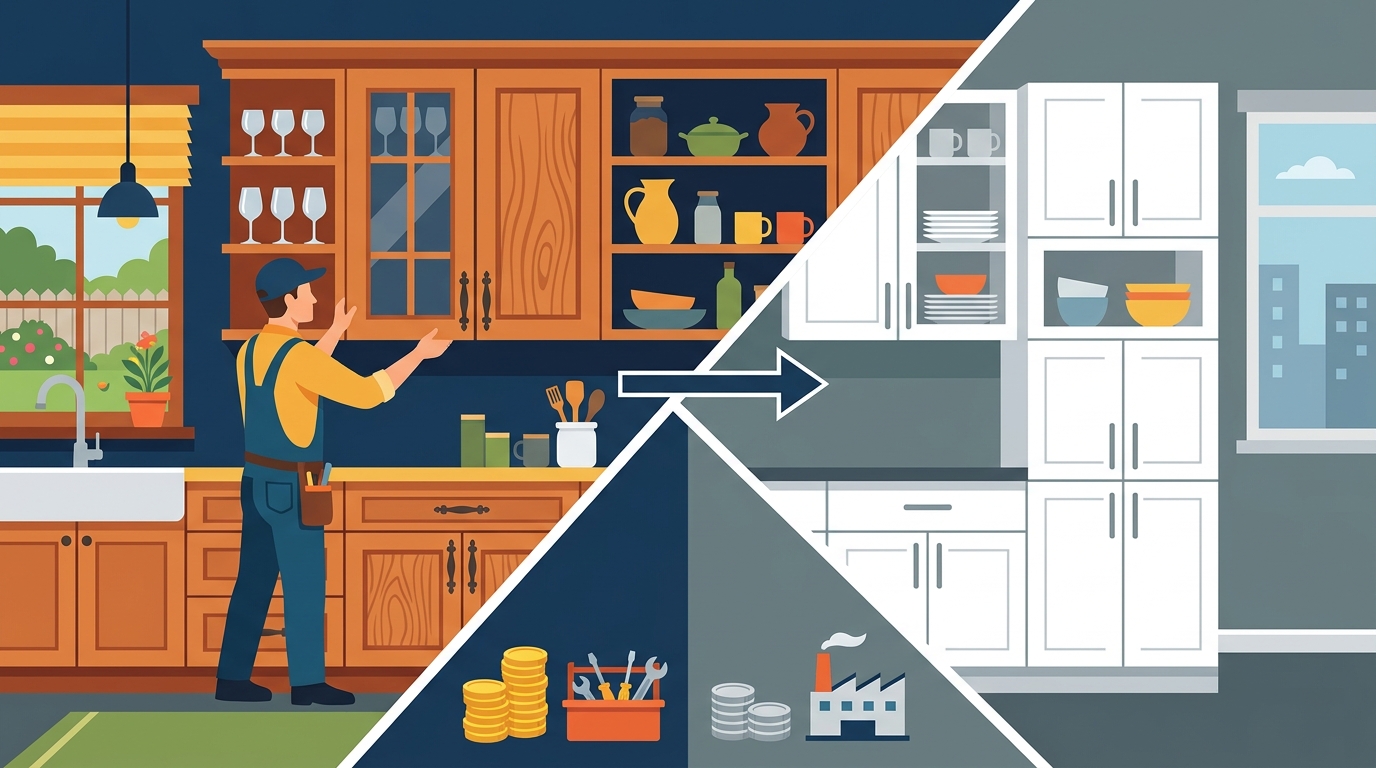
Choosing between custom cabinets and stock cabinets can significantly affect your kitchen renovation budget, storage capacity, and overall design. Custom cabinets are worth considering when you need precise dimensions, specialized storage, or a personalized design, while stock cabinets are often the better choice for homeowners who want a more affordable solution with shorter lead times. The right option depends on your kitchen layout, priorities, and how long you plan to stay in your home.
Before committing to either option, compare the total installed cost, available materials, finish choices, installation requirements, and long-term functionality. Understanding these differences can help you invest in cabinetry that fits your home rather than paying for features you may not need.
What Is the Difference Between Custom and Stock Cabinets?
Custom cabinets are designed and built to meet specific measurements and design requirements, while stock cabinets are manufactured in standard sizes and configurations for ready-made selection. Both can work well in a kitchen renovation, but they offer different levels of flexibility, cost control, and customization.
What Are Custom Cabinets?
Custom cabinets are made to match your kitchen’s dimensions, preferred storage features, materials, and appearance. A cabinetmaker or cabinetry provider typically works from a detailed design to produce units that suit the available space.
Custom cabinetry may be especially useful when a kitchen has unusual corners, uneven walls, limited clearance, or specific storage requirements.
Common features include:
-
Cabinet widths and heights tailored to the available space
-
Specialized drawers, pullouts, dividers, and organizers
-
Personalized door styles, finishes, and hardware
-
Storage designed around particular appliances or cooking habits
-
Options for unusual layouts and architectural details
The main advantage is flexibility. However, custom work generally requires more design coordination, production time, and upfront investment.
What Are Stock Cabinets?
Stock cabinets are mass-produced in standardized dimensions, styles, and finishes. They are sold through cabinet retailers, home improvement stores, and other suppliers, making them a practical option for many conventional kitchen layouts.
Their main advantages include predictable product options, relatively straightforward ordering, and generally lower upfront costs.
Typical characteristics include:
-
Standard cabinet widths, depths, and heights
-
A predefined selection of door styles and finishes
-
Limited modifications to cabinet dimensions
-
Common storage configurations
-
Potentially shorter lead times, depending on availability
Stock cabinets are not necessarily low quality. Their durability depends on construction, materials, hardware, installation, and maintenance. The important distinction is that the design options are more restricted than those of fully custom cabinetry.
How Much Do Custom Cabinets Cost Compared With Stock Cabinets?
Stock cabinets generally cost less upfront because they are produced in standardized sizes and larger quantities. Custom cabinets typically cost more because they require individualized design, material selection, fabrication, and additional labor.
Your final price depends on the size of the kitchen, cabinet construction, finish, hardware, installation complexity, and whether the project includes demolition or modifications to existing walls and utilities.
What Factors Affect Cabinet Pricing?
Several factors can influence the total price of either cabinet type.
1. Materials and construction
Cabinet boxes, doors, drawer components, and finishes can vary considerably in cost. Plywood, particleboard, medium-density fiberboard (MDF), and solid wood each have different characteristics and price points.
The best choice depends on the intended application, moisture exposure, finish, and construction quality—not simply the material’s name.
2. Door styles and finishes
Simple slab or shaker-style doors may cost less than elaborate profiles or specialty finishes. Custom colors, specialty veneers, glazing, and hand-applied finishes can increase fabrication costs.
3. Hardware and storage accessories
Soft-close hinges, full-extension drawer slides, pullout organizers, and specialized corner-storage systems can improve usability but add to the budget.
4. Installation and site preparation
Labor costs can increase when installers need to accommodate uneven walls, modify cabinetry around existing plumbing, or make extensive adjustments to achieve a clean fit.
5. Delivery and project coordination
Special orders may involve additional shipping, handling, or coordination. Stock cabinets can also incur delivery charges, especially when several units must be sourced from different locations.
Which Option Offers Better Value for Money?
The better value depends on how much customization your kitchen actually needs. Stock cabinets often provide excellent value in straightforward layouts, while custom cabinetry may justify its higher cost when it solves specific space or functionality problems.
| Cost consideration | Stock cabinets | Custom cabinets |
|---|---|---|
| Initial purchase price | Generally lower | Generally higher |
| Design fees | Often limited | May be included or charged separately |
| Size modifications | Limited | Extensive flexibility |
| Storage accessories | Depends on the product line | Can be specified to suit your needs |
| Installation adjustments | May require fillers or modifications | Can be designed around the space |
| Lead time | Often shorter if in stock | Typically longer |
| Budget predictability | Often easier to establish | Depends on design complexity and specifications |
For a meaningful comparison, request itemized estimates that cover the same number of cabinets, construction standards, hardware, finishes, delivery, installation, and related work. Comparing purchase prices alone can make one option appear less expensive than it will be once installed.
Which Cabinet Type Offers More Storage Flexibility?
Custom cabinets provide greater storage flexibility because their dimensions and internal layouts can be designed around your belongings and kitchen workflow. Stock cabinets can still offer practical storage, but the available configurations depend on the manufacturer’s product range.
When Are Custom Cabinets Better for Storage?
Custom cabinets can make better use of difficult or unusual spaces, particularly when standard units leave large gaps or fail to accommodate specific storage needs.
They may be useful for:
-
Deep drawers for cookware and pots
-
Vertical dividers for baking sheets and cutting boards
-
Pullout shelves for pantry items
-
Dedicated storage for small appliances
-
Narrow cabinets for trays, spices, or cleaning supplies
-
Storage around unique architectural features
For example, a homeowner with a narrow kitchen may benefit from a carefully designed cabinet arrangement that keeps frequently used items accessible without obstructing walkways.
Custom storage is most valuable when it addresses a real daily problem. Adding expensive organizers that you rarely use may not justify the additional cost.
Can Stock Cabinets Provide Enough Storage?
Yes. Stock cabinets can provide ample storage when the kitchen has a conventional layout and the standard dimensions suit the available space.
Many product lines offer different cabinet widths, drawer configurations, wall cabinets, pantry units, and organizational accessories. Combining these components thoughtfully can create a functional kitchen without the expense of fully custom fabrication.
Before choosing stock cabinets, inventory your cookware, dishes, pantry supplies, and small appliances. This helps you determine whether the available cabinet configurations will meet your needs.
Which Option Offers Better Sizing and Design Flexibility?
Custom cabinets offer more precise sizing and greater control over the finished appearance. Stock cabinets work best when standard dimensions fit the room or when the homeowner is comfortable using fillers, trim, and other finishing pieces to complete the layout.
How Do Custom Cabinets Handle Unusual Kitchen Layouts?
Custom cabinets can be designed for spaces that are difficult to accommodate with standard units. This includes kitchens with angled walls, unusual ceiling heights, tight corners, or specialized appliance arrangements.
Because the cabinetry is planned around the room, it may be possible to reduce unused gaps and create a more cohesive appearance.
However, custom dimensions do not eliminate the need for careful planning. Designers and installers must still account for appliance clearances, plumbing, electrical access, ventilation, door swings, and safe movement through the kitchen.
What Happens When Stock Cabinets Do Not Fit Perfectly?
Stock cabinets can still work in kitchens that do not match standard dimensions exactly. Installers often use filler strips, end panels, trim, and carefully planned cabinet combinations to create a finished look.
These adjustments are common in cabinetry installation, but they should be considered during the design stage rather than left until the cabinets arrive.
If a room has substantial irregularities or requires many modifications, compare the cost of adapting stock cabinets with the cost of ordering custom units. The difference may be smaller than expected once labor and finishing materials are included.
Which Cabinets Offer Better Materials and Finish Options?
Custom cabinets generally offer a wider range of materials, finishes, and hardware combinations. Stock cabinets usually provide a curated selection that simplifies purchasing and helps keep costs more predictable.
What Material Options Should You Compare?
The cabinet material affects appearance, durability, maintenance, and resistance to moisture.
| Material | Potential advantages | Considerations |
|---|---|---|
| Plywood | Often strong and suitable for quality cabinet boxes | Quality and thickness vary |
| MDF | Smooth surface for painted doors and panels | Prolonged moisture exposure can cause damage |
| Particleboard | Often economical and widely available | Edge sealing and moisture protection matter |
| Solid wood | Natural grain and refinishing potential | Can expand, contract, or change appearance with humidity |
| Veneered panels | Natural wood appearance with efficient material use | Quality depends on substrate and veneer construction |
No single material is best for every application. A well-constructed cabinet using an appropriate engineered material can outperform a poorly constructed cabinet made with a more expensive material.
Are Custom Finishes Worth the Extra Cost?
Custom finishes may be worth paying for when a specific color, wood tone, or door design is central to your kitchen’s appearance. They can also help coordinate cabinetry with existing flooring, countertops, and architectural details.
Stock finishes are often sufficient if you prefer a popular neutral color or a standard door profile. They can also make future replacement or expansion easier when the same product line remains available.
For homes in humid climates such as South Florida, ask how the cabinet materials, finishes, and exposed edges perform under normal indoor humidity conditions. Proper ventilation, moisture control, and prompt cleanup of spills are important regardless of cabinet type.
How Do Installation Time and Project Schedules Compare?
Stock cabinets can often be installed sooner when the required units are available, while custom cabinets generally need additional time for design approval, fabrication, finishing, and delivery. Actual schedules vary by supplier, product availability, project complexity, and installer workload.
What Is the Typical Installation Process?
Both cabinet types require accurate measurements, careful planning, and professional installation when the project is complex.
A typical process includes:
-
Measure the kitchen. Record wall dimensions, ceiling height, appliance openings, windows, doors, and utility locations.
-
Finalize the layout. Confirm cabinet placement, storage requirements, clearances, and countertop dimensions.
-
Confirm specifications. Review materials, finishes, hardware, product sizes, and installation responsibilities.
-
Prepare the space. Complete necessary demolition, repairs, and utility work before installation.
-
Install and level the cabinets. Secure units properly and align doors, drawers, and finished panels.
-
Complete the finishing work. Install fillers, trim, hardware, countertops, and any required adjustments.
Custom cabinetry may require more coordination before fabrication begins because design changes can affect the production schedule. Stock cabinetry may be delayed if key sizes or finishes are unavailable.
How Can You Avoid Cabinet Installation Delays?
To reduce delays, confirm measurements and specifications before ordering. Verify appliance dimensions, delivery dates, product availability, and who is responsible for addressing damaged or missing components.
Avoid making major layout changes after fabrication or ordering has started. Even a small adjustment can affect countertop measurements, plumbing connections, and adjacent finishes.
Which Cabinet Type Is Better for a Kitchen Renovation?
Neither option is automatically better for every renovation. Stock cabinets are often ideal for homeowners who prioritize affordability and a straightforward installation, while custom cabinets suit projects that require unusual dimensions, specialized storage, or a distinctive design.
When Should You Choose Stock Cabinets?
Stock cabinets are worth considering when:
-
Your kitchen has a relatively standard layout.
-
Your budget is limited or tightly defined.
-
Standard sizes provide sufficient storage.
-
You like the available colors and door styles.
-
You want to minimize design and fabrication time.
-
You can achieve a finished appearance with standard trim and fillers.
Stock cabinets are particularly practical when the goal is to refresh an existing kitchen without making major structural or layout changes.
When Should You Choose Custom Cabinets?
Custom cabinets may be the better investment when:
-
Your kitchen has unusual dimensions or architectural features.
-
Standard cabinets leave significant unused space.
-
You need storage designed around specific equipment or routines.
-
You want a particular finish or cabinet configuration.
-
You are completing a comprehensive kitchen redesign.
-
You value a tailored appearance enough to justify the added expense.
A custom solution should solve identifiable design or functionality needs. If standard cabinets can achieve the same result, the additional investment may be unnecessary.
How Should You Compare Cabinet Quotes Before Buying?
The best way to compare custom and stock cabinets is to request detailed quotes based on the same kitchen layout, material standards, hardware, finishes, and installation scope. This makes it easier to identify genuine differences in value.
Use this checklist when reviewing proposals:
-
Cabinet box material, thickness, and construction method
-
Door and drawer material and finish
-
Hinges, drawer slides, and included hardware
-
Number and dimensions of cabinet units
-
Fillers, trim, end panels, and decorative details
-
Storage accessories and organizational features
-
Delivery, installation, and site preparation costs
-
Warranty coverage and exclusions
-
Estimated production and installation schedule
-
Procedures for handling damaged or incorrect components
Also ask whether the estimate includes countertop installation, plumbing adjustments, electrical work, demolition, and disposal. These items may be quoted separately and can substantially affect the total project budget.
If you are planning a larger kitchen update, review kitchen remodeling services to explore how cabinetry fits into the overall renovation scope.
For a broader project, Remodeling services can also be a starting point for coordinating cabinetry with other interior improvements.
Do Custom Cabinets Increase Home Value More Than Stock Cabinets?
Custom cabinets do not automatically increase a home’s resale value more than stock cabinets. Their contribution depends on the quality of the finished kitchen, buyer preferences, the property’s price range, and how well the renovation fits the rest of the home.
A thoughtfully designed kitchen with durable, attractive cabinetry can improve everyday usability and buyer appeal. However, spending more on custom features does not guarantee that the added expense will be recovered when the property is sold.
For homeowners preparing to sell, attractive stock cabinets may be a sensible choice if they provide a clean, cohesive appearance without exceeding the renovation budget. For homeowners planning to stay for many years, custom storage and finishes may deliver greater personal value through daily convenience.
The most practical approach is to balance resale considerations with your own needs, the home’s existing condition, and the expected length of ownership.
Frequently Asked Questions
Are custom cabinets always more expensive than stock cabinets?
Custom cabinets generally have a higher upfront cost because they require individualized design and fabrication. However, the total price difference depends on materials, installation, modifications, and the complexity of the kitchen.
Do stock cabinets last as long as custom cabinets?
Stock cabinets can last for many years when they are well constructed, properly installed, and maintained. Cabinet quality depends more on materials, hardware, workmanship, and moisture management than on whether the cabinets are custom or stock.
Can stock cabinets look high-end?
Yes. Stock cabinets can create a polished appearance when paired with coordinated hardware, suitable lighting, attractive countertops, and careful installation. Well-planned trim and filler pieces can also help the finished kitchen look cohesive.
Are custom cabinets better for small kitchens?
Custom cabinets can be advantageous in small kitchens because their dimensions and storage features can be tailored to the available space. However, stock cabinets may be more cost-effective when standard sizes fit the layout without significant compromises.
Can I mix custom and stock cabinets?
Yes. A hybrid approach can balance cost and flexibility. For example, you might use stock cabinets for most of the kitchen and add a custom pantry, specialized corner unit, or tailored cabinet around an unusual architectural feature.
How do I know which cabinet option is right for my home?
Start by identifying your budget, storage needs, preferred finishes, and kitchen measurements. Compare detailed quotes for both options when possible, then choose the solution that meets your requirements without paying for customization you do not need.
Final Thoughts
Choosing between custom cabinets and stock cabinets comes down to the relationship between budget, design flexibility, storage needs, and installation requirements. Stock cabinets are often the practical choice for conventional kitchens and cost-conscious renovations, while custom cabinets can be worth the extra investment when standard options cannot deliver the desired fit or functionality.
Before making a decision, compare complete installed costs, review material specifications, and confirm the project timeline. A carefully planned cabinet installation can improve how your kitchen looks and functions without requiring the most expensive option available.