
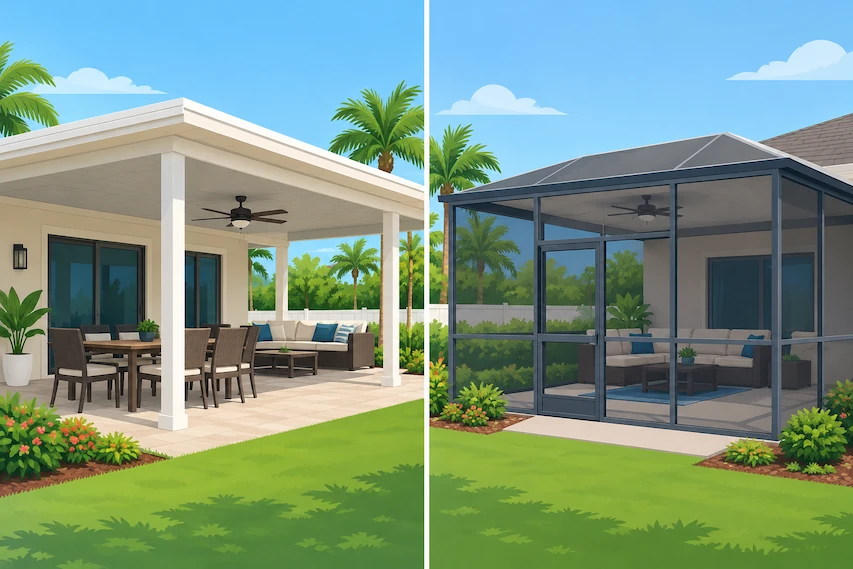
A covered patio and a screened patio can both make outdoor living more comfortable in South Florida, but they solve different problems. A covered patio primarily protects against direct sun and rain, while a screened patio adds a barrier against mosquitoes and other insects. The right choice depends on your budget, weather protection needs, ventilation preferences, and local building requirements.
If you’re comparing a covered patio vs. a screened patio in Florida, consider how you plan to use the space throughout the year. Understanding the differences in construction, maintenance, and permitting will help you choose an outdoor improvement that fits your home and lifestyle.
What Is the Difference Between a Covered Patio and a Screened Patio?
A covered patio has a roof or overhead structure that provides shade and some protection from rain, while a screened patio uses mesh panels to create a barrier against insects. Some screened patios also have solid roofs, combining shade and rain protection with improved insect control.
The most important distinction is that a roof and a screen serve different purposes. A roof blocks overhead sunlight and precipitation, while screen panels allow air to circulate and help keep flying insects out.
What Is a Covered Patio?
A covered patio is an outdoor living area with a roof supported by posts, columns, or an attached structural system. Depending on its design, it may use metal roofing, shingles, or another suitable roofing material.
Common covered patio features include:
-
A solid roof for shade and rain protection.
-
Open sides for natural ventilation.
-
Ceiling fans and outdoor lighting.
-
Outdoor dining furniture or lounge seating.
-
Optional privacy panels or retractable shades.
A covered patio is particularly useful for homeowners who want to enjoy outdoor dining, relax in the shade, or protect patio furniture from direct sun and some weather exposure.
However, an open-sided covered patio does not automatically keep mosquitoes or other insects away. Wind-driven rain can also reach the floor and furniture, depending on the roof design and the direction of the weather.
What Is a Screened Patio?
A screened patio is an outdoor space enclosed with mesh panels installed within a frame. It can have an existing roof, a newly constructed roof, or another approved overhead structure.
Common features include:
-
Mesh panels that help prevent insects from entering.
-
Airflow through the enclosure.
-
A roof or overhead cover for shade and rain protection.
-
Screen doors for convenient access.
-
Optional privacy screens or other enclosure features.
A screened patio is a practical choice for South Florida homeowners who want to enjoy fresh air without constantly dealing with mosquitoes and other flying insects.
The level of weather protection depends on whether the enclosure has a solid roof. A screened patio with no overhead cover will not provide the same shade or rain protection as a roofed enclosure.
Which Patio Is Better for South Florida Weather?
A roofed patio generally provides better protection from direct sunlight and overhead rain, while a screened patio provides better insect control. For South Florida’s hot, humid climate, a roofed screened patio can combine both advantages when properly designed and permitted.
Neither option is completely weatherproof. Strong winds, wind-driven rain, humidity, and tropical storms can affect both structures.
How Does a Covered Patio Handle Sun and Rain?
A covered patio reduces direct sun exposure and gives you a more comfortable place to sit outdoors during hot weather. Its effectiveness depends on roof coverage, orientation, height, and the amount of shade provided throughout the day.
A properly designed roof can also help protect outdoor furniture and reduce direct rainfall on the patio surface. However, an open-sided structure may still experience rain during storms, particularly when wind pushes water underneath the roof.
For Florida homes, roof materials, connections, drainage, and structural design should account for local weather conditions and applicable building codes.
Does a Screened Patio Protect Against Rain and Heat?
A screened patio can improve comfort by reducing insect exposure while allowing natural ventilation. However, the screen itself does not provide substantial rain protection or block most direct sunlight.
If heat and rainfall are major concerns, consider a screened enclosure with a solid roof. This configuration provides shade and overhead rain protection while allowing air to move through the mesh panels.
The actual temperature inside the enclosure will still depend on sun exposure, airflow, roof insulation, and surrounding landscaping.
Which Option Is Better During Hurricane Season?
Neither a standard covered patio nor a standard screened enclosure should automatically be considered hurricane-proof. Their ability to withstand severe weather depends on engineering, materials, anchoring, connections, and the approved design.
Before construction, ask your contractor how the proposed structure addresses applicable wind loads, roof attachment, drainage, and required product approvals. Do not assume that a screen enclosure can safely remain exposed to every storm condition.
How Much Does a Covered or Screened Patio Cost in Florida?
The cost of a covered patio vs. a screened patio in Florida depends on size, materials, foundation conditions, structural complexity, roof design, and permitting requirements. A simple shade structure generally involves less work than a roofed and fully screened enclosure with electrical features or custom finishes.
For initial planning, the following are broad illustrative budget ranges rather than verified current contractor quotes.
| Patio project | Illustrative planning range |
|---|---|
| Basic open patio cover | $5,000–$15,000 |
| Mid-range covered patio | $10,000–$25,000 |
| Screen enclosure added to an existing suitable patio | $3,000–$10,000 |
| Covered and screened patio | $10,000–$30,000+ |
| Custom roofed outdoor living area | $25,000–$50,000+ |
These ranges can overlap significantly and should not be treated as guaranteed South Florida market prices. A contractor needs to assess the property, structural requirements, material selections, and project scope before providing a reliable estimate.
For broader budgeting context, review Top Renovations’ South Florida home renovation cost guide. A patio project should be priced according to its specific construction requirements rather than using whole-home renovation costs as a direct comparison.
What Factors Affect Patio Installation Costs?
Several details can make one patio project considerably more expensive than another.
1. Patio size. A larger patio requires more roofing, framing, screening, hardware, and labor.
2. Roof materials. Metal roofing, shingles, insulated roof panels, and other systems have different material and installation costs.
3. Existing foundation. A suitable concrete slab may reduce the need for additional foundation work. An uneven surface or inadequate existing structure may require repairs or reconstruction.
4. Structural requirements. Attached roofs, long spans, unusual layouts, and site-specific wind requirements can increase engineering and construction costs.
5. Screen quality and framing. Standard mesh, upgraded insect screening, and specialized screen systems differ in cost and durability.
6. Electrical and finishing work. Lighting, ceiling fans, outlets, flooring, drainage improvements, and other additions can increase the total budget.
7. Permits and professional services. Permit fees, drawings, engineering, inspections, and required product approvals may add to the project cost.
How Can You Compare Contractor Estimates?
Request itemized estimates that clearly identify what each contractor will provide. Comparing the final price alone can be misleading when proposals include different materials or construction tasks.
Check whether each estimate includes:
-
Demolition and disposal, if required.
-
Foundation or slab preparation.
-
Structural framing and roof installation.
-
Screening, doors, and hardware.
-
Electrical work and lighting, if requested.
-
Permit applications, drawings, and inspections.
-
Drainage and finishing work.
-
Warranty coverage and exclusions.
For more complex outdoor renovations, a detailed scope of work makes it easier to compare proposals and identify missing costs before construction begins.
Do Covered and Screened Patios Require Permits in Florida?
A new patio roof or screen enclosure may require a building permit, and zoning requirements may also apply. The exact requirements depend on the structure, location, construction scope, and the authority responsible for permitting your property.
Miami-Dade County, for example, identifies aluminum terraces and patio covers among projects requiring permits and lists documentation requirements for applicable installations. The county also explains that new screen enclosures and additions may require permits. Review the official Miami-Dade County patio cover and aluminum terrace requirements and its general homeowner permit guidance.
Homeowners in Fort Lauderdale and elsewhere in Broward County should confirm requirements with the relevant city or county building department. Requirements can differ between municipalities.
What Documents Might You Need?
Depending on the project, the permitting authority may request:
-
A building permit application.
-
A property survey or site plan.
-
Construction drawings showing dimensions and placement.
-
Structural details and engineering documents where required.
-
Product approval documentation for applicable materials.
-
Contractor information and required signatures.
-
Additional zoning approvals or supporting documents.
For certain aluminum patio covers in Miami-Dade County, the county specifies design drawings signed and sealed by a design professional and a current Notice of Acceptance or acceptable product approval documentation.
The required documents depend on the structure and local rules. Confirm the current checklist with your permitting authority before purchasing materials or starting construction.
How Do Setbacks and Property Lines Affect Patio Construction?
A patio may need to comply with zoning setbacks, easements, height restrictions, lot coverage limits, and other property-specific requirements. A design that fits physically in your backyard is not necessarily permitted in that location.
Before finalizing your layout, verify property boundaries and the location of any utility or drainage easements. If your home is part of a homeowners association, check its architectural approval process as well.
What Happens If You Build Without a Required Permit?
Unpermitted construction can create problems during inspections, refinancing, insurance reviews, or a future property sale. Correcting the issue may require additional documentation, inspections, fees, or modifications to the existing structure.
The safest approach is to confirm permit requirements before work begins and retain copies of approved plans, permits, inspection records, and contractor documentation.
Which Patio Offers Better Ventilation and Insect Protection?
A screened patio generally provides better insect protection while allowing airflow through its mesh panels. A covered patio with open sides can provide excellent natural ventilation, but it does not prevent insects from entering.
The best choice depends on whether your main concern is airflow, shade, mosquitoes, or a combination of these factors.
Does Screening Reduce Airflow?
Screen mesh allows air to pass through, but the degree of airflow depends on the mesh type, enclosure size, wind direction, and surrounding obstructions. Finer mesh or additional privacy panels may restrict airflow more than a more open screening system.
If natural ventilation is a priority, discuss mesh options and enclosure layout with your contractor. Ceiling fans can also improve comfort when outdoor air is warm and humid.
Can You Keep Mosquitoes Out of a Screened Patio?
Properly installed screens can substantially reduce mosquito entry when the mesh, doors, and surrounding frames remain intact. Small gaps, damaged panels, or doors left open can undermine the enclosure’s effectiveness.
To improve insect control:
-
Choose screening designed for your intended use.
-
Ensure doors close securely.
-
Repair tears and gaps promptly.
-
Remove standing water from nearby containers and other breeding areas.
-
Keep vegetation and outdoor clutter from obstructing maintenance access.
A screened enclosure does not eliminate every insect, but it can make outdoor dining and relaxation more comfortable.
Which Patio Is Easier to Maintain?
A covered patio usually requires less enclosure-specific maintenance because it has fewer screen panels, tracks, and door components. A screened patio requires additional inspections to keep the mesh, frames, and entry points in good condition.
Both options need routine checks for weather damage, drainage problems, corrosion, and deterioration.
How Do You Maintain a Covered Patio?
Inspect the roof, supports, fasteners, and drainage system periodically. Remove leaves and debris from gutters where installed, check for leaks, and address corrosion or deteriorating finishes before the damage spreads.
After severe weather, look for loose connections, displaced roofing materials, and changes in the structure’s alignment. Have significant damage evaluated by a qualified professional.
How Do You Maintain a Screened Patio?
Check mesh panels for tears, inspect doors and latches, and clean the screen and frame according to the manufacturer’s recommendations. Replace damaged mesh promptly to preserve insect protection.
Also inspect the roof, fasteners, and enclosure connections. Florida’s humidity and coastal conditions can accelerate deterioration in some materials, so suitable corrosion-resistant components and routine maintenance are important.
Is a Covered Patio or Screened Patio Better for Home Value?
Either option can improve the usability and appeal of an outdoor living area, but neither guarantees a specific increase in resale value. The result depends on local buyer preferences, construction quality, maintenance, usable space, and how well the design complements the property.
A covered patio may appeal to homeowners who prioritize shade, outdoor dining, and flexible furniture arrangements. A screened patio may be more attractive to buyers who want to enjoy fresh air with fewer insects.
A well-designed combination can provide both benefits, particularly in South Florida, where outdoor living is practical for much of the year. Still, the project should fit your budget and lifestyle rather than rely solely on an assumed return on investment.
How Do You Choose the Right Patio for Your Home?
The best patio is the one that addresses your main comfort needs while meeting your budget and local construction requirements. Compare your priorities before committing to a design.
| Your priority | Option to consider |
|---|---|
| Shade and overhead rain protection | Covered patio |
| Fewer mosquitoes and flying insects | Screened patio |
| Shade, rain protection, and insect control | Roofed screened patio |
| Open-air feel with fewer enclosure components | Covered patio |
| Enclosed outdoor dining area | Roofed screened patio |
| A more customized outdoor living space | Professionally designed patio suited to your property |
Before making a decision, follow these steps:
-
Define how you will use the space. Decide whether you mainly want shade, insect control, outdoor dining, or a place to relax during rainy weather.
-
Evaluate the existing patio. Check the slab, drainage, house attachment points, and available yard space.
-
Set a realistic budget. Include construction, materials, permits, professional services, and a contingency for unexpected work.
-
Verify local requirements. Contact the building department for your property and confirm whether permits, zoning approval, or engineering documents are needed.
-
Compare itemized estimates. Make sure contractors are quoting the same scope, materials, and project features.
-
Plan for long-term maintenance. Consider roof upkeep, screen repairs, drainage, and resistance to local weather conditions.
If your project involves more than the patio alone, explore Top Renovations’ home remodeling services to understand how an outdoor upgrade can fit into a broader property improvement plan.
Frequently Asked Questions
Is a covered patio better than a screened patio in Florida?
A covered patio is generally better for shade and overhead rain protection, while a screened patio is better for reducing insect entry. A screened patio with a solid roof can combine both benefits.
Is it cheaper to build a covered patio or a screened patio?
The lower-cost option depends on the project scope. A simple roof may cost less than a roofed, fully screened enclosure, but adding screens to an existing suitable patio may be relatively economical. Compare itemized estimates rather than assuming one option is always cheaper.
Do I need a permit to screen in an existing patio in Florida?
A screen enclosure may require a building permit, even when a patio slab already exists. Requirements depend on your local jurisdiction and the proposed work, so confirm with the relevant building department before construction.
Can I add a roof to an existing screened patio?
Possibly, but the existing frame, foundation, and connections must be suitable for the proposed roof. Additional structural work, engineering, product approvals, and permits may be required.
Does a screened patio keep out rain?
No. Screens alone do not provide meaningful rain protection. A solid roof can protect against overhead rainfall, although wind-driven rain may still enter through open sides.
Which patio is better for mosquitoes?
A properly installed screened patio generally offers better mosquito protection than an open-sided covered patio. The result depends on the condition of the mesh, door seals, and other openings.
Can a patio be both covered and screened?
Yes. A roofed screened patio combines overhead shade and rain protection with mesh panels that help keep insects out. Its design must still meet applicable structural and permitting requirements.
How much should I budget for a South Florida patio?
The budget depends on size, materials, foundation conditions, roof design, screening, labor, and permits. Broad planning ranges can help with early decisions, but a site assessment and itemized contractor estimate are needed to establish a reliable project price.
Final Thoughts
When comparing a covered patio vs. a screened patio in Florida, focus on the problems you want to solve. A covered patio provides shade and overhead rain protection, a screened patio helps keep insects out, and a roofed screened patio combines the two in one outdoor living space.
Before moving forward, evaluate your property, compare construction estimates, and confirm the applicable building and zoning requirements. With careful planning and a design suited to South Florida’s climate, you can create an outdoor area that is comfortable, functional, and easier to maintain over time.